Nobody warned me how confusing structured data would be the first time I ran into it.
I was auditing a client's site — a local service business, nothing fancy — and I noticed a competitor's Google listing had these expandable question-and-answer dropdowns sitting right below their title and meta description in the search results. Their listing was taking up three times the space mine was. Same keyword, same page position, dramatically different presence.
I spent an afternoon figuring out what that was, and by the end of it I understood something that changed how I think about SEO entirely: the way you mark up your content matters just as much as the content itself.
That expandable format was FAQ schema. And while Google has tightened the rules around when it shows up since then, the underlying value of FAQ schema has not gone away. If anything, it has gotten more important — just in ways that most people haven't fully caught up with yet. This is the explanation I wish someone had given me back then.
So What Exactly Is FAQ Schema?
Let's start at the beginning and skip the jargon for a moment.
When Google crawls your website, it reads HTML. It can see your headings, your paragraphs, your links. But it can't always tell, with certainty, what type of content each piece is. Is this paragraph a product description? A review? A question and answer? Without context, Google has to guess.
Schema markup is a way of giving Google that context directly. It's a standardized vocabulary — maintained by a consortium called Schema.org — that lets you label your content in a way search engines understand unambiguously. You're not guessing that Google will figure out what your content is. You're telling it outright.
FAQ schema specifically uses a markup type called
FAQPage. It tells Google: this section of my page contains frequently
asked questions, here are the exact questions, and here are the exact answers. Google
doesn't need to interpret anything — you've handed it the structure on a plate.
The format used to implement it is called JSON-LD — JavaScript
Object Notation for Linked Data — placed inside the <head> of
your page. Here's what the basic structure looks like:
{
  "@context": "https://schema.org",
  "@type": "FAQPage",
  "mainEntity": [
    {
      "@type": "Question",
      "name": "What is FAQ schema?",
      "acceptedAnswer": {
        "@type": "Answer",
        "text": "FAQ schema is a type of structured data markup that tells search engines which parts of a page contain question-and-answer content."
      }
    }
  ]
}
That's the bones of it. Each question-and-answer pair follows the same structure: a
Question type with a name (the question) and an
acceptedAnswer with a text field (the answer). You can
have as many pairs as you need.
A Brief History: What FAQ Schema Used to Do
For a few years — roughly 2019 through mid-2023 — FAQ schema was something of a cheat code for search visibility.
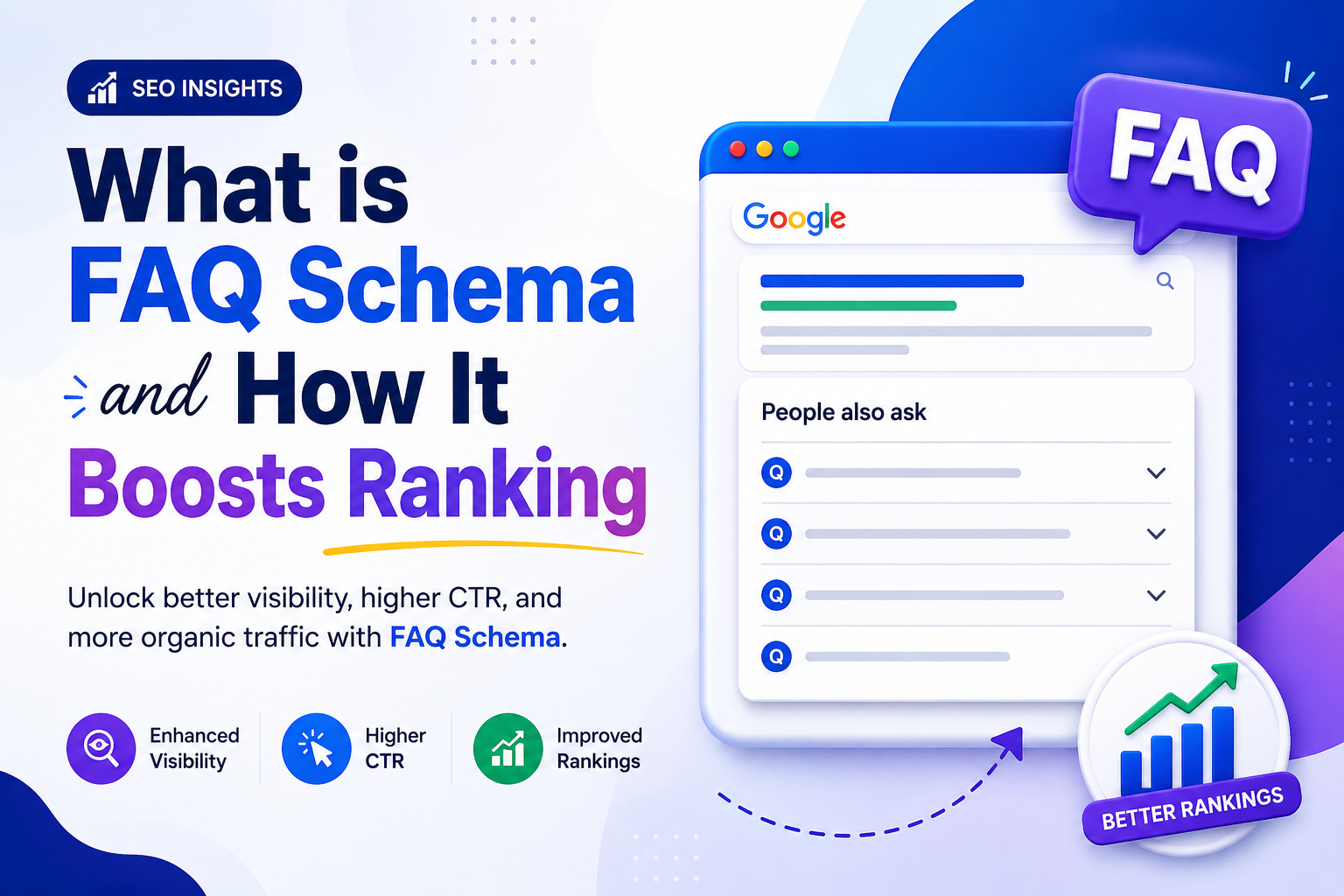
When implemented correctly, Google would expand your search result to show two or three FAQ dropdowns directly in the SERP. Your result went from taking up three or four lines of screen space to taking up eight or ten. On mobile especially, this was enormous — a single FAQ-enhanced result could dominate the visible area before anyone even started scrolling.
Then, in August 2023, Google significantly restricted the feature. Expandable FAQ rich results were limited to government websites and health authority pages for most search queries. For the rest of us, those automatic dropdowns in the SERP mostly stopped appearing.
Key Insight: If you read any SEO commentary from around that time, you might have seen people declaring FAQ schema dead. That reaction was understandable but shortsighted. The format of how it showed up in Google's results changed. The underlying value of having well-structured FAQ content did not.
What FAQ Schema Actually Does for Rankings in 2026
Here's where the conversation gets more interesting — and where most explainers stop too early. FAQ schema isn't just about one type of Google result. When you implement it and build genuine FAQ content around it, you're doing several things at once.
It helps you earn featured snippets
Featured snippets — those paragraph or list extractions that appear above the regular results — are still very much alive and valuable. Google pulls featured snippet content from pages that answer questions clearly and concisely. An FAQ section built with structured answers in the 40–60 word range is almost perfectly formatted for featured snippet extraction. The schema markup itself doesn't guarantee a snippet, but it signals to Google's systems that this content is specifically designed to answer questions.
It feeds Google AI Overviews
This is the one that matters most in 2026 and that most people are still sleeping on. Google AI Overviews — the AI-generated summaries appearing at the top of results for many queries — pull from structured, trustworthy content across the web. Pages with clean Q&A structure and proper schema markup are heavily represented in AI Overview citations. Getting cited in an AI Overview puts your brand name and URL in front of a searcher before they've even scrolled to the regular results.
Key Insight: That kind of visibility was not really available three years ago in the same way. The businesses investing in structured FAQ content right now are positioning themselves for a type of search presence that most competitors haven't thought about yet.
It improves your chances of being cited by ChatGPT and Perplexity
When someone asks a question in ChatGPT's browsing mode or in Perplexity, those systems crawl the web and select sources to cite. The pages they consistently prefer share common traits: clear topical focus, direct answers to specific questions, and structured content that's easy to parse. Building your pages with structured FAQ content — and marking it up correctly — puts you in the pool of pages those systems trust. That pool is smaller than you might think, because most pages are still built with zero structured data at all.
It keeps Bing rich results accessible
Bing never followed Google's 2023 restrictions. Bing still shows FAQ rich results — the expandable dropdown format — for websites that implement FAQ schema correctly, across all industries and query types. For certain industries and demographics, Bing's share of search traffic is larger than people assume, and FAQ schema is still producing the full visual enhancement there.
It improves page structure and dwell time
Pages with well-built FAQ sections are easier for readers to navigate. Someone who finds your page through a search query can scroll to the FAQ section and get a direct answer to what they were looking for. They stay on the page longer. They're less likely to hit the back button immediately. Google's ranking systems pay attention to engagement signals, and a page that consistently holds attention longer than competing pages has an edge.
| Platform / Feature | FAQ Schema benefit | Status in 2026 |
|---|---|---|
| Google expandable rich results | Visual SERP dropdown expansion | Restricted — gov & health sites only |
| Google featured snippets | Direct answer extraction above results | Active ✓ |
| Google AI Overviews | Citation in AI-generated summaries | Active & growing ✓ |
| Bing rich results | Expandable FAQ dropdowns in SERP | Fully active for all sites ✓ |
| ChatGPT / Perplexity citations | Source cited in AI answer engines | Active & rising ✓ |
| People Also Ask | Content surfaced in PAA boxes | Active ✓ |
| Dwell time / engagement | On-page clarity & navigation | Always active ✓ |
The Rules You Need to Know Before Implementing FAQ Schema
Google has specific guidelines around FAQ schema, and violating them can result in your structured data being ignored — or worse, triggering a manual action against your site.
- Every question in your schema must be visibly present on the page. You can't add JSON-LD markup for questions that are hidden from users, collapsed permanently, or only exist in the code. This is the most commonly violated rule — people add schema in the code for SEO purposes while burying the actual FAQ content from real users.
- Answers must be genuine and informative. Schema markup that links to answers elsewhere — or that provides non-answers like "contact us for more information" — won't earn rich results treatment and may be flagged as manipulative.
- Don't mark up promotional content as FAQs. Questions designed to pitch your product rather than answer genuine user questions are not what this format is for. "Is your service the best on the market?" is not a FAQ. Google's quality evaluators know the difference.
- Keep it relevant to the page. FAQ schema on a dog grooming page should contain questions about dog grooming — not tangential keywords you're trying to rank for. Off-topic FAQ schema gets devalued quickly.
Pro Tip: After implementation, run your page through Google's Rich Results Test to confirm your markup is valid and error-free. It takes about sixty seconds and tells you immediately whether your schema is eligible for rich results treatment.
How to Build FAQ Content That Actually Earns Search Visibility
The schema markup itself is fairly mechanical once you understand the format. The harder part is building FAQ content that genuinely earns the visibility benefits. A few principles that consistently produce results:
Research actual questions, not guessed ones
The best source of FAQ content is the questions your customers are already asking — in support tickets, in sales calls, in Google's People Also Ask results for your target keywords. Answer those questions specifically. Don't invent questions nobody is asking.
One clear answer per question
The temptation is to turn every FAQ answer into a mini-essay. Resist it. A direct, clear answer of 40–80 words is more useful to readers and more likely to be extracted by search engines than a 300-word response to a simple question. If a question genuinely requires a longer answer, it probably works better as a standalone blog post than as an FAQ entry.
Match the language of your audience
If your customers call something a "social media ad" and you keep calling it a "paid digital placement," your FAQ content will miss. Write in the language your customers actually use — including in the question phrasing itself.
Update your FAQs periodically
FAQ content goes stale. Products change, pricing changes, industry terminology changes. A quarterly review of your FAQ sections — checking that answers are still accurate and adding new questions that have come up recently — keeps your structured data healthy and your schema eligible for continued benefits.
The Fastest Way to Implement FAQ Schema on Your Pages
Writing questions, formatting answers, and manually coding JSON-LD is time-consuming — especially across multiple pages at once. A ten-page service site might need forty or fifty FAQ pairs before you've adequately covered the content. The work compounds quickly.
This is exactly the problem the GeoTools free FAQ generator is built to solve. You paste in a URL, the AI reads the actual content of that page, generates relevant question-and-answer pairs based on what the page is about, and gives you schema-ready JSON-LD output you can paste directly into your site.
- No account or login required — paste and go
- No generic questions — output is specific to your actual page content
- Schema-ready output — validates cleanly in Google's Rich Results Test
- Follows Google's current guidelines — visible content, direct answers, proper JSON-LD format
Pro Tip: Use the GeoTools FAQ generator on pages already ranking in positions 5–15 on Google — these are pages search engines have already validated as relevant. Adding structured FAQ content to them is one of the fastest ways to push them toward featured snippets and People Also Ask positions without rebuilding the page from scratch.
The Bottom Line
FAQ schema is not a trick or a loophole. It never was. It's a way of communicating clearly to search engines what your content is and what questions it answers — and giving those engines the confidence to surface your page in rich formats, AI summaries, and featured positions.
The SERP enhancement that made FAQ schema famous in 2019 is mostly gone for regular commercial sites. But the content signal it creates — structured, direct, question-answering content — is more valuable now than it was back then, because that's exactly the signal Google AI Overviews, ChatGPT citations, and featured snippet algorithms are looking for.
The business that builds clear, structured FAQ content across their key pages today is the business whose name keeps appearing in AI-generated answers next year. That kind of compounding visibility doesn't happen by accident.
It happens because someone took the time to build it right.
Build your FAQ schema the right way — try the free FAQ generator on GeoTools. Paste your URL and get schema-ready output in seconds. No login required.