A huge chunk of your audience is no longer searching on Google the way they used to. They're typing full questions into ChatGPT, asking Perplexity for a summary, and letting Siri or Alexa read them an answer — without ever clicking a single link. That's created a brand-new discipline called Answer Engine Optimization (AEO). This guide breaks down what it is, how it differs from SEO, and exactly what you can do about it right now GeoTools.
What Is Answer Engine Optimization (AEO)?
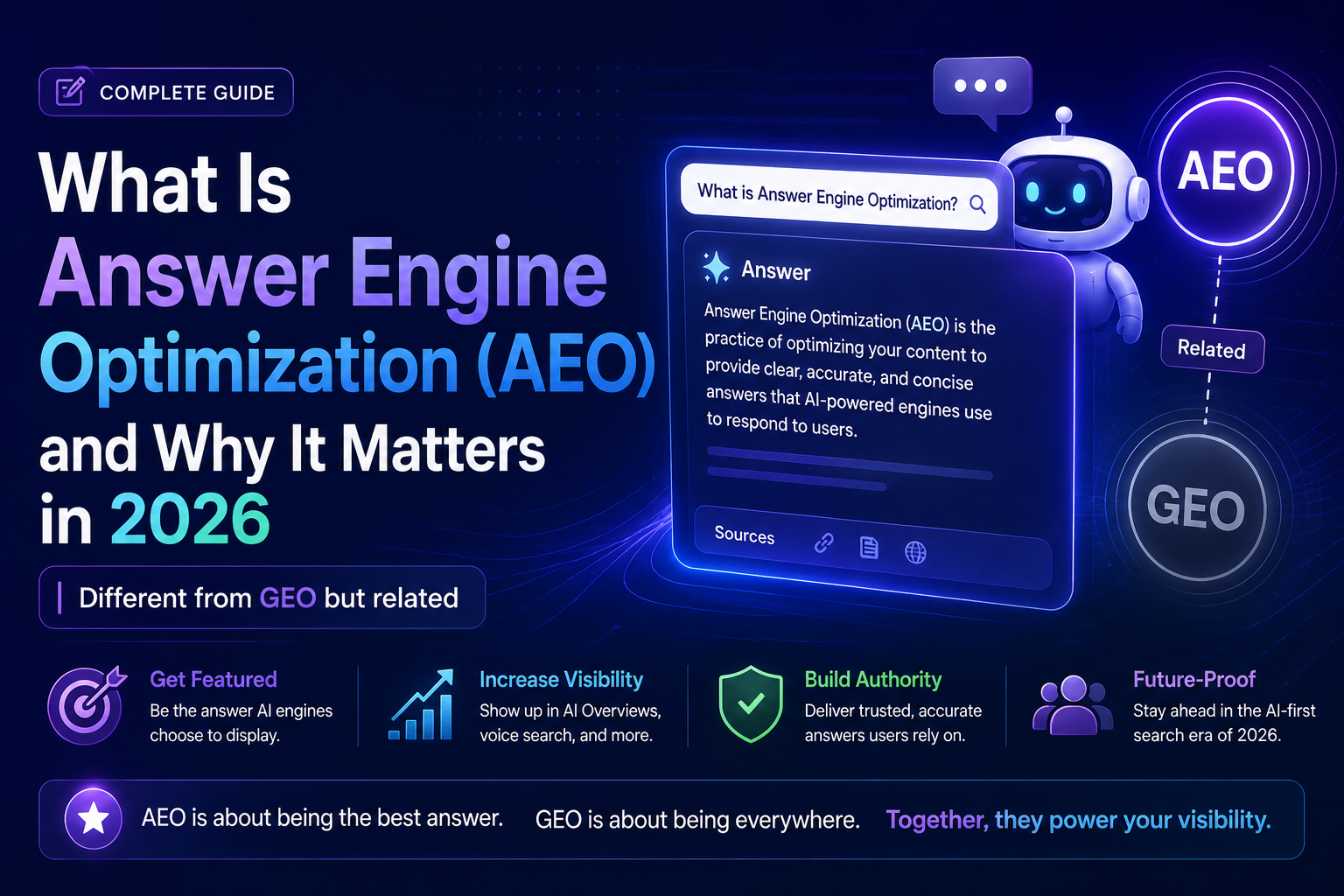
Answer Engine Optimization is the practice of optimizing your content so it gets selected, surfaced, and cited by AI-powered answer engines — tools like ChatGPT, Google's AI Overviews, Perplexity, Siri, Alexa, and Bing Copilot — as the direct response to a user's question.
Key Insight: AEO says — "Get your content chosen as the answer so AI repeats it, with or without a click." An "answer engine" is any AI-powered system that gives users a direct answer instead of a list of links. AEO is about optimizing for all of them.
AEO vs SEO — What's Actually Different?
A lot of people assume AEO is just a fancy rebrand of SEO. It isn't. They're related — same family, different goals.
| Dimension | Traditional SEO | AEO |
|---|---|---|
| Goal | Rank in the top ten blue links on Google | Be cited as the answer by AI tools |
| Success Metric | Clicks and organic traffic | Mentions, citations, and brand visibility in AI responses |
| Best Format | Long-form content built around keywords and backlinks | Clear Q&A structure, concise direct answers, structured schema data |
| Primary Reader | Human visitors | AI systems parsing content on behalf of users |
Pro Tip: You can rank #1 on Google for a keyword and still be completely invisible in AI-generated answers. And you can be cited by ChatGPT regularly without ever cracking the top five on Google. They are genuinely different games — but they share the same foundations of quality content, clear structure, and genuine authority.
How Is AEO Different from GEO?
These two disciplines are closely related but target different outcomes:
- SEO — Rank in the list of search results
- AEO — Be the direct, featured answer (the snippet Google reads aloud, the result Alexa recites). Success is measured in featured snippet appearances and voice search visibility.
- GEO (Generative Engine Optimization) — Be included in AI-generated content. Success is measured in AI mentions and citations.
In 2026, you really want to be doing all three. A quick way to remember it: AEO means be the answer, GEO means be in the generated content, SEO means rank in the list.
Why Does AEO Matter So Much Right Now?
The way people search has fundamentally shifted — and it's only going to accelerate. People now ask full questions and expect immediate, conversational answers. That's exactly what AI answer engines deliver.
- Over half of all Google searches already end without a click — users got what they needed from the result page itself.
- ChatGPT now attracts over three billion monthly users searching for answers.
- Google's AI Overviews are accelerating the zero-click trend dramatically in 2026.
- When ChatGPT recommends a tool or service, users often act on it without further research.
- When Perplexity cites your article, that's a credibility signal that money can't directly buy.
Key Insight: Being the trusted answer in AI responses earns you something more durable than a ranking — it builds brand recognition at scale.
How Do Answer Engines Actually Choose an Answer?
When someone types a question into an AI answer engine, the system follows a logical process — not a random selection.
- Parse intent — Not just the words, but what the user is really asking. "What's a good coordinate converter?" means a tool recommendation, not a definition of coordinate systems.
- Retrieve candidate sources — The AI searches its training data and/or the live web for authoritative, well-structured pages that appear to answer the question.
- Evaluate quality and trustworthiness — The system looks for domain reputation, content structure, schema markup, and writing clarity. This is essentially your EEAT score in action.
- Extract or generate the answer — If the content is clear and direct, the AI can lift the exact answer. If not, it synthesizes from multiple sources — which is why clear, concise writing beats buried insights every time.
- Cite or surface the source — Depending on the platform, your content may be cited with a link (Perplexity), shown in a snippet (Google AI Overview), or used without citation (some ChatGPT responses).
Pro Tip: AI answer engines are not perfect — they sometimes hallucinate, misattribute, or oversimplify. AEO doesn't eliminate that risk, but clear, structured content significantly reduces the chances of your site being misrepresented.
7 AEO Tactics That Work in 2026
1. Write in Question-and-Answer Format
Use the actual question as a heading, then answer it directly in the first 40 to 60 words. No preamble. Just the answer. This is the single highest-impact change most sites can make.
2. Add FAQ Schema Structured Data
FAQ Schema is JSON-LD markup that tells Google exactly which questions and answers live on a page. It directly feeds Google's AI Overview and rich results. If you've never added schema markup before, FAQ Schema is the place to start — it's beginner-friendly and has immediate impact on featured snippets and voice search.
3. Target Long-Tail, Question-Based Keywords
Keywords like "best free coordinate converter online" or "what is the difference between UTM and decimal degrees" are pure gold for AEO. They have clear intent, match how people phrase questions to AI, and face far less competition than broad keywords. Tools like AnswerThePublic and AlsoAsked are excellent for finding these.
4. Build EEAT Signals Into Every Page
EEAT (Experience, Expertise, Authoritativeness, Trustworthiness) is Google's framework for judging content quality. For AEO, this means:
- Naming the author and their credentials
- Including robust About and Contact pages
- Linking to reputable external sources
- Getting cited by authoritative sites
- Keeping content factually accurate and up to date
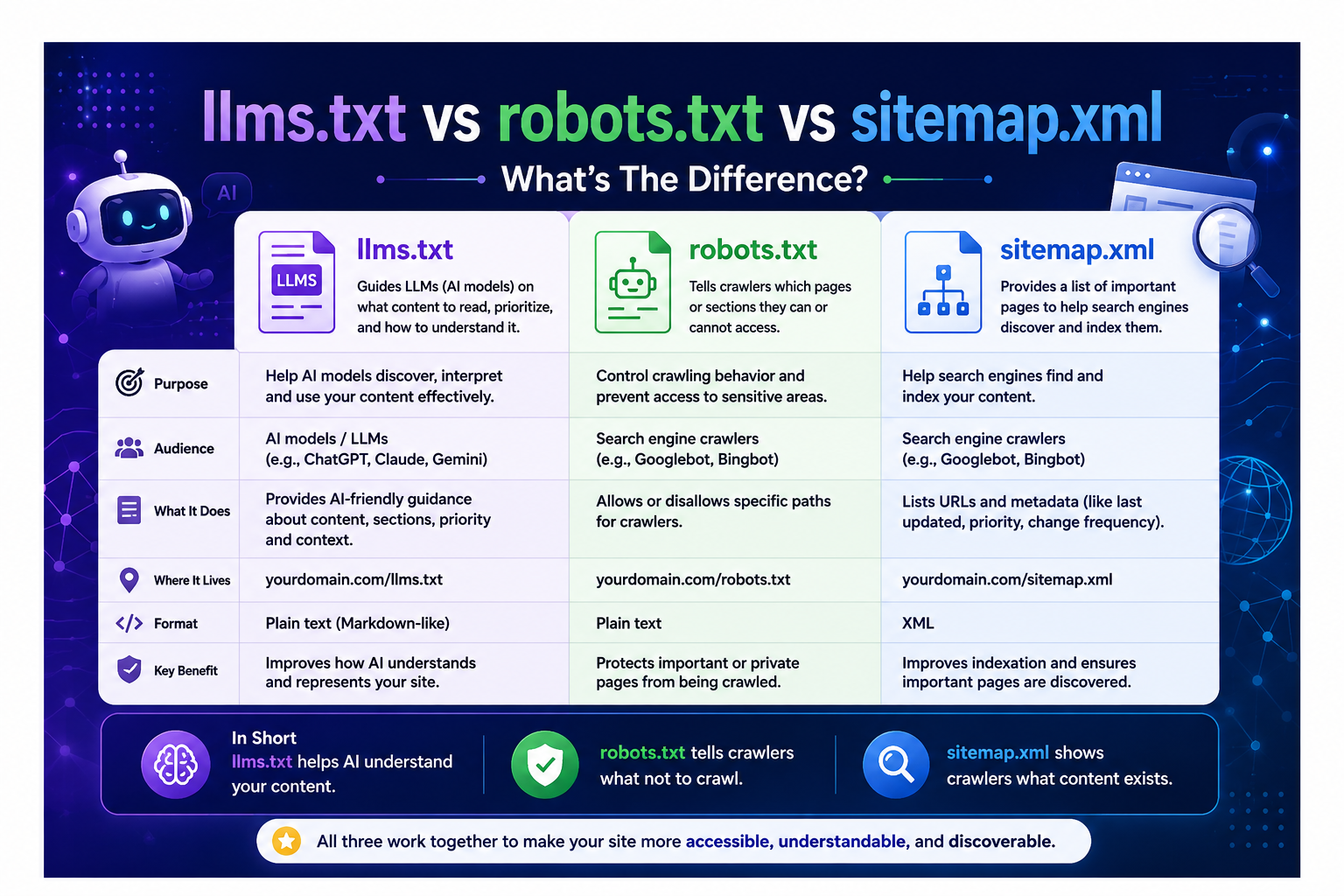
5. Create a Comprehensive llms.txt File
This file gives AI models a clean, Markdown-formatted summary of your site. When AI systems crawl your site, this file is the first thing they should find. It's the most direct signal you can send an AI about your site's identity and purpose.
6. Use Concise "Answer Blocks" in Your Content
Include a clearly formatted TL;DR or summary box near the top of each article — two to four sentences that directly answer the main question. Write your answer for the AI to quote, then elaborate for human readers below it.
7. Earn Citations from Authoritative Sources
AI systems learn what's trustworthy partly by seeing what authoritative sources link to. If Wikipedia, academic papers, industry publications, or well-known tools link to your content, that's a strong signal of reliability. This is the AEO equivalent of link building — and it matters just as much.
Common AEO Mistakes Beginners Make
- Burying the answer in the middle of a long intro. If your answer doesn't appear in the first paragraph, AI systems might miss it entirely. Answer first, explain after. Every time.
- Using jargon without explanation. AI answer engines favour content understandable without prior knowledge. Unexplained acronyms or technical terms make your content less likely to be surfaced for general queries.
- Treating AEO and SEO as separate strategies. They're complements, not opposites. Content that ranks well on Google and content that gets cited by AI should be the same piece, built with both audiences in mind.
- Ignoring schema markup because it seems technical. FAQ Schema, Article Schema, and HowTo Schema are baseline requirements for AEO in 2026. Plugins like Yoast SEO or Rank Math make adding them genuinely simple.
- Measuring AEO success only through clickthrough rate. AEO sometimes means zero clicks — your answer was read in an AI response and the user moved on. That's not a failure. Track brand mentions in AI tools, featured snippet appearances, and voice search impressions alongside traditional traffic metrics.
AEO Quick-Start Checklist for 2026
Work through these one by one to get ahead of the vast majority of websites on AEO readiness:
- Answer the main question within the first 60 words of every article
- Use the actual question as an H2 or H3 heading, not a paraphrase
- Add FAQ Schema markup to every question-focused page
- Include Article Schema with author name, date, and organization
- Create or update your
llms.txtfile at your domain root - Add an "About the Author" section with credentials to key pages
- Research question-based keywords using AnswerThePublic or AlsoAsked
- Write a TL;DR summary block at the top of long-form content
- Ensure your site loads fast — AI crawlers deprioritize slow pages
- Keep content factually accurate and include a "Last Updated" date
Pro Tip: If you want to start with just three things — write direct answers at the top of every page, add FAQ Schema, and create your
llms.txtfile. Those three changes alone will put you ahead of most sites competing for AI visibility right now.
The Future Belongs to Whoever Answers Best
There's a version of the web in the near future where most information retrieval doesn't involve a search results page at all — where people ask questions, get answers, and move on, GeoTools with AI acting as the trusted curator in between. That world is already here for a lot of queries.
The brands and creators winning in this environment aren't gaming an algorithm or tricking a machine. They're simply being genuinely helpful — and making it easy for AI to know that they are.