Let's be direct. If you've noticed your traffic getting a little quieter over the last year despite maintaining solid rankings, you're not imagining things. Google didn't flip a switch overnight, but the shift has been real and it's accelerating fast. The way people find things on Google has fundamentally changed — and most website owners are still playing by the old rules.
This post breaks down exactly how Google's AI search system works in 2026, why it matters for your site, and the specific steps you can take right now to make sure you're showing up in the answers people actually see.
What Is Google AI Search, Really?
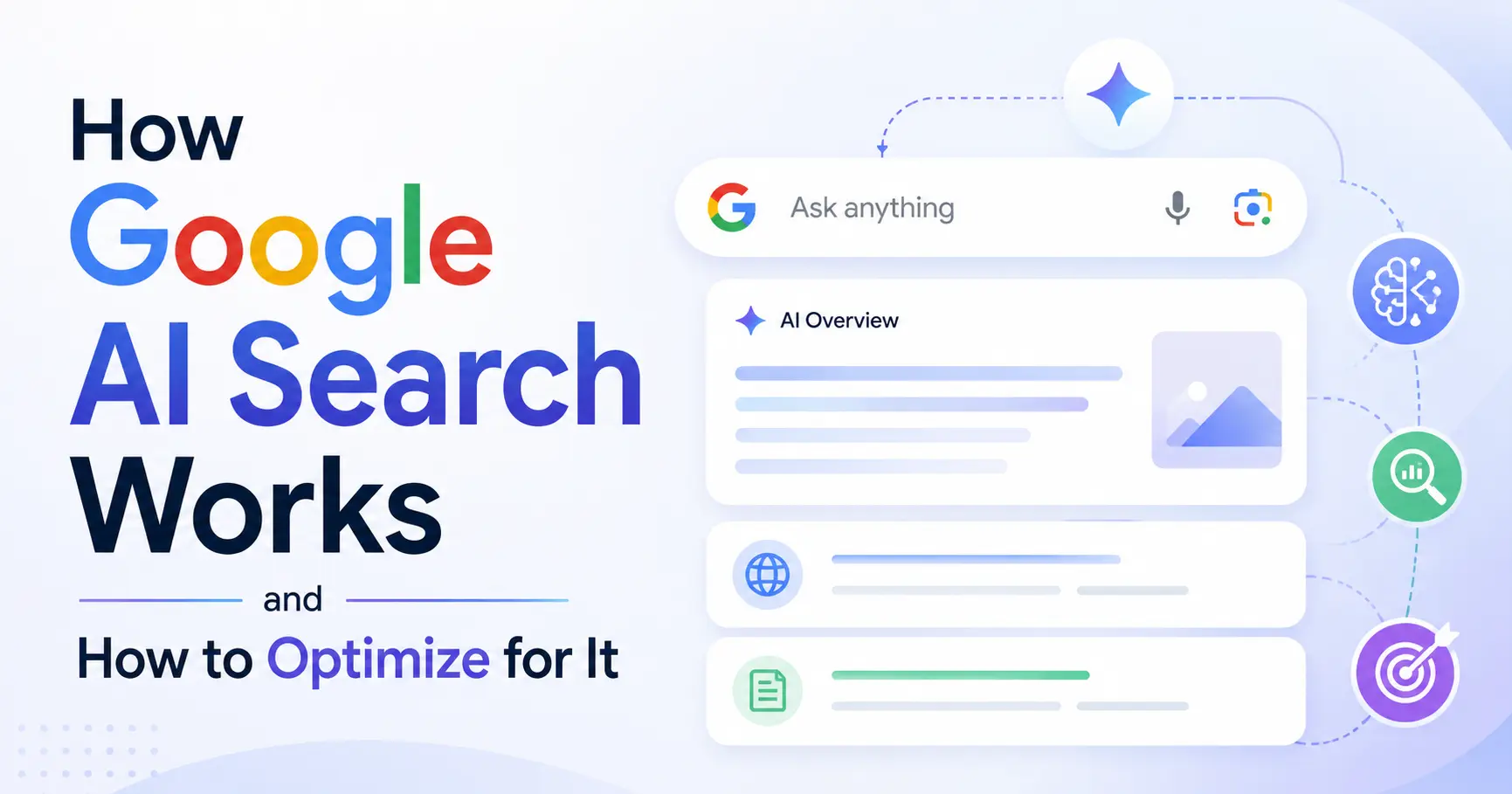
Google's AI search operates through two main features: AI Overviews and AI Mode. AI Overviews are AI-generated summaries that appear at the very top of search results — above the traditional blue links — and directly answer the user's question. AI Mode goes a step further, creating a fully conversational search experience where Google synthesizes a complete response from multiple sources before showing anything else.
Think of it this way: before, Google was a librarian pointing you toward books. Now it's reading the books for you and giving you the summary. It still tells you which books it used, but a lot of people never pick them up.
Key Insight: Both AI Overviews and AI Mode use a "query fan-out" technique — Google issues multiple related searches across subtopics and data sources simultaneously. Its AI models then synthesize everything into one coherent response, identifying supporting web pages along the way. It's not reading one article and rewriting it; it's reading dozens and building something new.
AI Overviews launched widely in 2024. By February 2026, they were appearing on roughly 48% of all tracked queries — up from 31% just a year earlier. Some industries are seeing them on nearly 90% of searches. If your audience is in healthcare, tech, education, or B2B services, AI search is probably already reshaping how they find you.
The Harsh Truth About What This Means for Traffic
When AI gives someone the answer directly on the search page, they often don't click anything. This is called zero-click search, and the numbers are uncomfortable. Research from early 2026 shows click-through rates dropping as much as 61% on keywords where AI Overviews consistently appear — even for pages sitting at position six or above.
Pro Tip: Being cited in an AI Overview is not just about surviving lower CTR. Brands that appear in AI-generated answers build recognition and trust in a way that traditional rankings never quite managed. When Google's AI says "according to [your website]..." every time someone searches for something in your space, that's a different kind of authority entirely.
But here's what most people miss: roughly 52% of queries still trigger no AI Overview at all. Classic search isn't dead. You need to win at both.
What Google Actually Looks For
Google's own documentation is refreshingly honest here: there are no special tricks or separate requirements to appear in AI Overviews. The AI features draw from the same pool of indexed, high-quality content that traditional search does. Strong SEO is still the foundation. But the way you build that content matters more than ever.
| Signal | Why It Matters for AI Search | Priority |
|---|---|---|
| Content Structure | AI prefers clear Q&A formats, logical H2/H3 hierarchies, and direct opening sentences that immediately address the topic. | ? High |
| Data & Statistics | Pages with original data and verifiable statistics see 30–40% higher visibility in AI responses. | ? High |
| Topical Authority | AI systems use topical depth as a trust signal. Thorough topic coverage outperforms shallow content regardless of domain age. | ? High |
| Freshness | Around 44% of AI Overview citations came from 2025 content. Keeping pages updated is a direct input to citation likelihood. | ? Medium |
| Schema Markup | Structured data helps Google's AI understand content with more precision — FAQ, HowTo, and Article schema are most valuable. | ? High |
| E-E-A-T Signals | Experience, Expertise, Authority, and Trust determine whether your content is safe for AI to cite publicly. | ? High |
There's one more piece of the puzzle that most guides skip over: the correlation between traditional rankings and AI citations is strong. Studies show that 40–76% of pages cited in AI Overviews also appear in the top 10 organic results. Getting into AI search is not a shortcut around traditional SEO — it runs on top of it.
10 Things You Can Do Right Now
Enough context. Here's what actually moves the needle, based on what's working in 2026.
1. Build Proper FAQ Sections on Every Important Page
Around 78% of AI-generated responses are structured as lists or Q&A pairs. When you write a FAQ, you're handing the AI content that's already formatted the way it wants to output it. Use FAQ schema markup (JSON-LD) to make it even easier for Google to identify and cite.
2. Answer the Question in the First Two Sentences
Google's AI doesn't skim to the good part — it evaluates the structure. Lead every article and section with the direct answer, then elaborate. If someone asks "what is X," the first sentence of your page should define X. Don't warm up for three paragraphs before getting to the point.
3. Use Schema Markup Properly
Structured data in JSON-LD format helps Google's AI understand what your content is about with more precision. FAQ schema, HowTo schema, and Article schema are the three most valuable for AI citation purposes. Google has doubled down on the importance of structured data at recent Search Central events.
4. Add Original Data and Cite Your Sources
Research from Princeton and the University of Delhi found that including citations, statistics, and quotations from credible sources can increase AI visibility by over 40%. Don't just make claims — back them up. Run original surveys or compile data your competitors haven't published. It gives AI a reason to cite you specifically.
5. Build Content Clusters, Not One-Off Posts
Topical authority compounds. A single great article won't establish you as a trusted source — a full cluster of interconnected, in-depth content on a topic does. Use a pillar-and-cluster model: one comprehensive guide linking out to deeper dives on each subtopic. Internal links reinforce the structure for both humans and AI crawlers.
6. Keep Your Technical SEO Clean
A page can't be cited if it can't be crawled and indexed. Check your robots.txt, resolve any 404 errors and redirect chains, fix canonical tag issues, and make sure no important content is hidden behind JavaScript rendering. Page speed matters too — Google has raised the bar on Core Web Vitals as AI features prioritize faster-loading sources.
7. Build Your E-E-A-T Signals Deliberately
Experience, Expertise, Authority, and Trust. This isn't just a checklist — it's the lens through which Google's AI evaluates whether your content is safe to cite. Author bios with real credentials, references to first-hand experience, links from trusted publications, and a consistent brand presence across the web all feed into this score.
8. Optimize Your Images and Add Alt Text Everywhere
AI Overviews use multimedia to enhance responses. Images with descriptive, keyword-rich alt text contribute to your overall relevance signals. It's one of those small things that quietly holds back rankings when it's missing — and costs almost nothing to fix.
9. Create an llms.txt File for Your Site
While Google states it doesn't use llms.txt for rankings, other AI platforms — Claude, Perplexity, ChatGPT's browsing mode — benefit from it. As AI-driven search expands beyond Google, having a structured file that tells AI models exactly which pages matter is a smart forward-looking move. GeoTools' llms.txt Generator builds this in seconds from your URL.
10. Track AI Visibility Separately from Traditional Traffic
Google Search Console now includes AI Overview data under the "Web" search type, but doesn't separate it. Use manual spot checks — search your target keywords and note whether AI Overviews appear and whether your site is cited. Tools like Semrush's AI Toolkit and dedicated GEO platforms are worth monitoring. What you don't measure, you can't improve.
A Word on Keywords and Low-Competition Queries
Here's something that should feel like good news. According to Semrush data, nearly 80% of keywords that trigger AI Overviews fall in the 0–40% keyword difficulty range. The highly competitive, high-volume terms that big brands dominate aren't where AI search is most active right now. Informational, conversational, long-tail queries are — and that's exactly the kind of content a focused, well-structured website can win on without a decade-old domain.
The Opportunity: Low-competition informational queries are exactly where a focused AI search optimization approach wins fast — even without massive domain authority. If your site answers specific, niche questions better than anyone else, Google's AI will find it and use it. That's the opening.
What About Your Meta Tags?
While meta tags alone won't determine whether you appear in AI Overviews, they still matter for traditional rankings — and remember, strong traditional rankings and AI citations are closely correlated. A well-crafted title and meta description affects your click-through rate, which affects your overall performance signals. If you're not optimizing these properly, you're leaving organic traffic on the table.
GeoTools' Meta Tag Generator uses Llama 3.3 to produce multiple high-performing variations for any page, automatically capping them at the correct pixel widths so Google doesn't cut off your text mid-sentence.
The Bottom Line
Google's AI search isn't something that's coming — it's already reshaping how your audience finds information right now. The sites that show up in AI Overviews aren't lucky. They're well-structured, technically sound, topically authoritative, and written to directly answer the questions people are actually asking.
None of that requires a massive budget or a team of engineers. It requires being more intentional about how you produce and structure content, and making sure the fundamentals — crawlability, speed, schema, internal linking — are handled properly.
Quick Wins to Start This Week: Run a free SEO audit at GeoTools SEO Checker, generate a structured FAQ section for your top pages, add FAQ schema markup, and create an llms.txt file. These four steps alone put you ahead of most sites in your space.
The search landscape is moving fast. But the websites that combine solid technical SEO with properly structured, citation-worthy content are the ones that will keep their visibility — and actually grow it — as AI search keeps expanding. That's the game now. Worth playing.