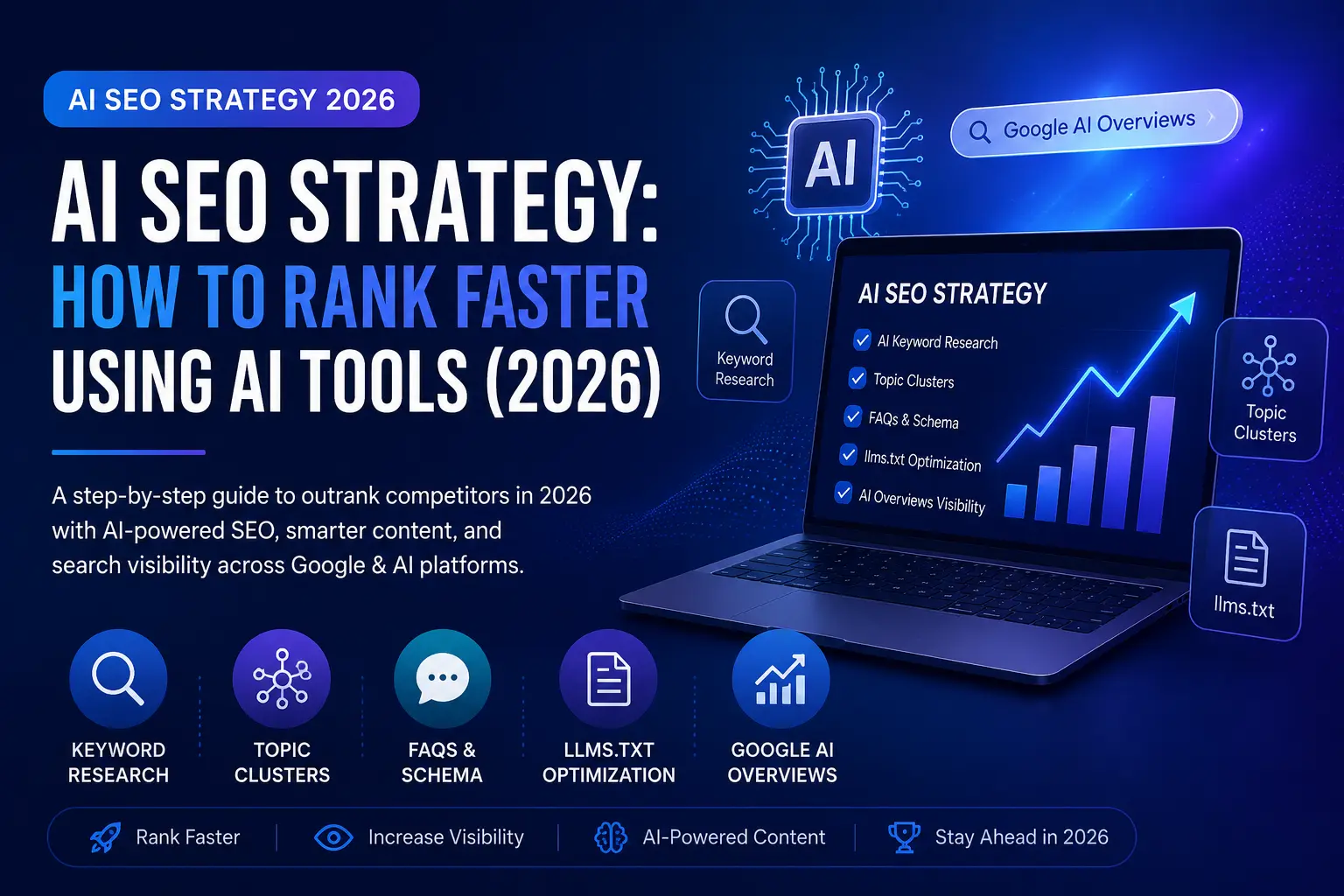
If you're still doing SEO the old way — manually hunting keywords, writing meta tags one by one, guessing what competitors are doing — you're already behind.
In 2026, AI has fundamentally changed how websites rank. The teams winning in search aren't working harder. They're working with smarter tools — and they're getting results in weeks instead of months.
This guide breaks down a complete AI SEO strategy you can start using today. And yes — we'll show you exactly how tools like the ones at GeoTools.live fit into every step of the process.
Why Traditional SEO Alone Isn't Enough in 2026
For twenty years, SEO meant the same thing: find keywords, write content, build backlinks, climb the rankings. That formula still works — but it's no longer the full picture.
Here's what's changed:
- Google AI Overviews now answer questions directly on the search page — before users ever click a link
- ChatGPT, Perplexity, and Gemini are becoming primary research tools for millions of users
- AI Overviews reduce click-through rates on top organic results by an average of 34.5%
- 73% of SEO professionals now say AI tools are a core part of their strategy
The goal has shifted. It's no longer just about ranking on page one. It's about being cited by AI — becoming the trusted source that answer engines pull from when generating responses.
The good news? AI tools make both goals achievable, faster than ever before.
Step 1: Smarter Keyword Research with AI
Why Old-School Keyword Research Is Dead
The old process — open Google, check Keyword Planner, pick a number, publish — was slow and unreliable. It told you how many people searched for a term, but not why, when, or what they actually wanted.
Modern AI keyword tools analyze search intent, contextual meaning, and long-tail opportunity simultaneously. They find keywords your competitors missed — not by looking at the same databases, but by understanding real human questions.
The Technique That Actually Works
Start by asking an AI tool to generate 30–50 keyword ideas around your core topic — specifically long-tail phrases of four or more words that signal clear intent. Then run them through a keyword tool to check volume and difficulty.
The sweet spot: 100–1,000 monthly searches, difficulty score under 30. These are terms where newer websites can realistically rank within 3–6 months.
- ❌ "SEO tools" — Difficulty: 90+. Nearly impossible for new sites.
- ✅ "free llms.txt generator for small business website" — Difficulty: 10–20. Achievable and highly specific.
Recommended AI Keyword Tools
- SEMrush AI — Intent mapping and keyword clustering
- Ahrefs — Competitor keyword gap analysis
- ChatGPT / Claude — Brainstorming long-tail variations
- AnswerThePublic — Real questions people are actually asking
Step 2: Build Topic Clusters — Not Just Single Articles
Publishing one article and hoping it ranks is a losing strategy in 2026. Google rewards topical authority — how deeply and comprehensively your site covers a subject.
AI makes building topic clusters dramatically faster. Instead of manually brainstorming supporting content for weeks, AI tools can map out an entire cluster in minutes.
What a Topic Cluster Looks Like
| Content Type | Example Page | Purpose |
|---|---|---|
| Pillar Page | Complete Guide to AI SEO Tools | Central authority page — links to all supporting articles |
| Supporting Article | What is an llms.txt File and Why Does It Matter? | Targets specific long-tail keyword, links back to pillar |
| Supporting Article | How to Generate FAQs That Rank in AI Overviews | Targets question-based query, builds topical depth |
| Supporting Article | Free SEO Audit Checklist for Small Business Websites | Captures comparison and checklist intent |
| Supporting Article | GEO vs SEO: What's the Difference in 2026? | Targets informational query, drives awareness |
Each supporting article links back to the pillar page and to each other. This signals to both Google and AI systems that your site is a genuine authority on the topic.
Tools to Build Clusters Faster
- Surfer SEO — Cluster planning with content scoring
- Frase.io — AI-powered content briefs based on SERP data
- ChatGPT / Claude — Generating cluster ideas from a single prompt
Step 3: Create Content AI Can Actually Cite
This is where most websites are leaving rankings on the table. AI systems — Google AI Overviews, ChatGPT, Perplexity — don't just favor long, detailed articles. They favor content that is structured to answer questions directly. And the single most powerful format for this in 2026 is the FAQ.
Why FAQs Are Your Most Valuable SEO Asset Right Now
Research shows that roughly 78% of AI-generated responses are structured as lists or Q&A pairs. When you publish a well-structured FAQ, you're handing AI systems content that's already in the exact format they need to generate an answer.
An AI model would rather pull a clean, direct answer from a three-sentence FAQ than dig through a 2,000-word blog post trying to find the key point. FAQ pages with FAQPage schema markup get cited in AI-generated responses at significantly higher rates than unstructured content.
Pro Tip: GeoTools' free FAQ Generator automatically scans your page and builds structured FAQs formatted for AI citation and Google's "People Also Ask" boxes — without writing a single word manually. Paste your URL and it does the rest.
The Right Content Creation Process
- Let AI do: Research, outlining, first drafts, meta tag suggestions, FAQ generation
- You do: Add personal experience, verify facts, inject your brand voice, include original examples
Use your target keyword in the title, first paragraph, one H2 heading, and meta description. Then use natural variations throughout. Google understands semantic relevance — repeating the exact phrase twenty times is unnecessary and counterproductive.
Step 4: Make Your Website AI-Ready with llms.txt
Here's a step most website owners are completely missing. As AI-powered search platforms crawl the web to generate answers, they need to understand your site quickly and accurately. A poorly structured site means AI systems skip your content — even if it's excellent.
llms.txt is an emerging file standard — similar in concept to robots.txt — that helps AI models identify exactly which pages on your website are most important and most worth citing.
Key Insight: GeoTools' llms.txt Generator does this in seconds. Enter your URL, select the pages you want AI systems to prioritize — your best blog posts, product pages, About page — and download a ready-to-upload file. No developer required, no code to write.
As AI-driven search continues to grow, having a well-structured llms.txt file gives your site a structural advantage over competitors whose pages are harder for AI to parse and cite correctly.
Step 5: Automate On-Page SEO
On-page SEO — optimizing titles, meta descriptions, headings, internal links, and schema markup — used to take hours per page. AI reduces this to minutes.
What AI Handles Automatically
- Meta Tags: AI tools analyze your content and suggest optimized title tags and meta descriptions based on target keywords and competitor data.
- Internal Linking: AI identifies opportunities to connect related content, builds logical site architecture, and distributes link value across your pages. On a 50-page site, this alone saves an entire workday.
- Schema Markup: Structured data — FAQPage, Article, BreadcrumbList, HowTo — tells search engines exactly what your content is about. AI tools generate and implement these automatically, increasing your chances of appearing in rich results.
On-Page AI Tools Comparison
| Tool | Best For | Price |
|---|---|---|
| RankMath AI | WordPress on-page optimization | Free / $$ |
| Surfer SEO | Content scoring + NLP suggestions | $$$ |
| GeoTools SEO Checker | Free on-page + technical audit | Free |
| Screaming Frog | Site-wide SEO crawl | $$ |
Step 6: Run Technical SEO Audits — Fast
Technical problems silently kill rankings. Slow pages, broken links, crawl errors, duplicate content, misconfigured robots.txt — Google sees all of it, and it all counts against you. The frustrating part is that these issues are often invisible until traffic has already dropped.
Key Technical Issues AI Catches
- Core Web Vitals — LCP, INP, CLS issues with specific fix recommendations
- Crawl Errors — 404s, redirect chains, and accidentally blocked pages
- Duplicate Content — Canonical tag problems and thin content flags
- Schema Errors — Invalid or missing structured data markup
- Mobile Usability — Issues specifically affecting mobile search rankings
Key Insight: GeoTools' free SEO Checker Tool handles this without requiring any technical knowledge. Enter your URL and get a complete audit covering on-page SEO, technical health, page speed, and keyword optimization — completely free, with no sign-up required.
Step 7: Competitor Gap Analysis with AI
One of the highest-ROI uses of AI in SEO is finding the exact keywords and topics your competitors rank for — that you don't. Upload competitor URLs into an AI-powered SEO platform and within minutes you get a breakdown of:
- Keywords they rank for that your site is missing
- Content topics they haven't covered that you can own first
- Featured snippet and "People Also Ask" opportunities they're holding
- Weaknesses in their content structure you can outperform
Pro Tip: You don't need to outperform competitors on everything. Find the gaps they've overlooked and move on them first. Domain authority matters less than answer clarity — a well-structured, specific page can outrank sites with years of history simply by being easier for AI to cite.
Recommended Competitor Analysis Tools
- SEMrush Keyword Gap — Side-by-side competitor keyword comparison
- Ahrefs Content Gap — Missing content topic opportunities
- RivalFlow AI — Identifies content underperforming vs. direct competitors
- GeoTools SEO Checker — Quick site health and on-page comparison
Step 8: Optimize for Google AI Overviews
Getting cited in Google AI Overviews is the new page-one ranking. This is the highest-priority optimization step in 2026.
Use Question-Based Headings
Structure your H2 and H3 headings as real questions people ask. "What is an llms.txt file?" performs far better in AI citations than "About llms.txt Files." AI systems match conversational queries to content that's already formatted as questions and answers.
Answer Directly and Immediately
After every question-formatted heading, provide a direct 2–3 sentence answer before adding any background context. AI systems extract the first clear answer they find — don't bury the key point in a long introduction.
Add FAQ Sections to Every Key Page
A well-structured FAQ section with FAQPage schema tells AI systems exactly what questions your page answers — and exactly what the answers are. This is the single most reliable tactic for increasing AI citation frequency.
Strengthen E-E-A-T Signals
- Author bios with real, verifiable credentials
- Cited sources and original data points
- Clear publication and last-updated dates
- Original examples and first-hand insight — not generic AI text
Step 9: Reach the Right People with Smarter Outreach
Building authority requires real relationships — with journalists, bloggers, industry websites, and partners who can link to and mention your brand. Cold email outreach is the most direct path to these connections. But most cold emails get ignored because they feel generic and impersonal.
Pro Tip: GeoTools' Cold Email Generator writes personalized outreach emails based on the specific person and purpose — not recycled templates, but messages written the way you would if you actually sat down and thought carefully about who you're contacting. The result: emails that feel human, get opened, and get replies.
Step 10: Track the Right Metrics in 2026
Tracking only keyword rankings in 2026 misses the bigger picture. Add these to your reporting dashboard:
AI Visibility Metrics
- Frequency of brand citation in AI Overview results for your target topics
- Growth in organic impressions from question-based and conversational queries
- Direct traffic trends — a reliable indicator of growing brand recognition
Traditional Metrics (Still Essential)
- Organic click-through rate broken down by individual page
- Core Web Vitals scores: LCP, INP, and CLS
- Indexed pages versus total published pages
- Backlink growth and domain authority over time
Tracking Tools
| Tool | What It Tracks | Cost |
|---|---|---|
| Google Search Console | Impressions, clicks, CTR, indexing status | Free |
| SEMrush AI Toolkit | AI-generated SERP features and citation tracking | $$$ |
| Ahrefs | Backlink monitoring and ranking history | $$$ |
| GeoTools SEO Checker | Free ongoing site health audits | Free |
Common Mistakes to Avoid
- Publishing raw AI content without editing: Generic AI output without human review sends a low-quality signal to Google. Always edit, add personal insight, and verify facts before publishing.
- Ignoring your FAQ sections: Most websites still treat FAQs as an afterthought. In 2026, they are your primary tool for AI citation and "People Also Ask" visibility.
- Skipping llms.txt: As AI search grows, having a structured llms.txt file gives you a visibility edge most competitors haven't considered yet.
- Optimizing for only one platform: Google, ChatGPT, Perplexity, Gemini — each surfaces content differently. Build content structured to perform across all of them.
- Treating AI as a replacement for strategy: AI tools accelerate execution. They do not replace thinking, expertise, or brand-building. The winning formula remains: AI speed + human judgment + consistent execution.
Your 30-Day AI SEO Action Plan
Week 1 — Foundation
- Run a free technical audit with GeoTools SEO Checker
- Generate your llms.txt file with GeoTools llms.txt Generator
- Perform AI-powered keyword research for your top 5 topics
Week 2 — Content
- Map out 2 topic clusters around your core services or products
- Add structured FAQ sections to your most important pages
- Generate and implement FAQPage schema markup site-wide
Week 3 — Optimization
- Optimize meta titles and descriptions with AI assistance
- Fix internal linking gaps identified in your audit
- Improve Core Web Vitals on your slowest pages
Week 4 — Outreach & Tracking
- Start targeted cold email outreach using GeoTools Cold Email Generator
- Set up AI visibility tracking across Google, ChatGPT, and Perplexity
- Review results, identify what's working, and adjust your strategy accordingly
Conclusion
AI SEO strategy in 2026 isn't complicated — but it does require a shift in thinking. The websites winning in search today aren't publishing more content. They're publishing structured, authoritative, AI-friendly content that earns citations, builds trust, and compounds over time.
Start with four fundamentals: a technical audit, an llms.txt file, strong FAQ sections, and AI-assisted keyword research. These steps alone put you ahead of the majority of websites competing in your space.
Everything you need to get started is free at GeoTools.live — no sign-up, no credit card, no complexity. Just tools that work.