Let me be straight with you.
I've watched a lot of smart salespeople and marketers spend hours writing a genuinely good cold email — the perfect hook, the right case study, a killer call to action — and then slap something like "Quick question" on the subject line and wonder why nobody opens it.
The subject line isn't a formality. It's the whole game.
In 2026, your prospect's inbox is a warzone. AI tools have made it stupidly easy to send thousands of cold emails, which means everyone is doing it, and most of it is identical, robotic slop. Buyers have become ruthless. They delete before they even consciously decide to delete.
If your subject line doesn't stop them mid-scroll, nothing else you wrote matters.
This post is about what actually works. Not theory. Not "best practices" written by someone who last sent a cold email in 2019. Real subject line formulas with real examples, plus honest notes on what's gotten stale and what still holds up.
Why Most Cold Email Subject Lines Fail
Here's the uncomfortable truth: most cold email subject lines fail because they're written for the sender, not the reader.
- "I'd love to connect" — that's about you.
- "Checking in on my last email" — that's about you.
- "We help companies like yours grow faster" — about you, vague, and boring.
The second you flip the frame and write a subject line that's clearly about the person reading it — their problem, their company, their world — open rates change.
There's also a trust problem in 2026. Readers have been burned by curiosity-bait subject lines that promised something interesting and delivered a generic pitch. They've seen "Re: our conversation" on emails from people they've never spoken to. They've trained themselves to smell automation.
Key Insight: The subject lines that cut through now are the ones that feel like they came from a real person who did five minutes of actual research. That bar sounds low. You'd be shocked how few people clear it.
The One Thing Every Good Subject Line Has
Before getting into formulas and examples, here's the single question every subject line needs to answer for the reader:
"Why is this relevant to me, right now?"
Not "why is this company cool." Not "what does this product do." Specifically: why should I, a busy person with 200 unread emails, open this particular one today.
Relevance beats cleverness every time. Specificity beats polish. A slightly awkward subject line that references something real about the recipient will outperform a perfectly crafted generic one.
7 Types of Cold Email Subject Lines That Still Work in 2026
1. The Direct Question
Questions work because they create an incomplete loop in the reader's brain. The mind wants to close it. A question also implies a two-way conversation — not a broadcast.
The key word here is direct. Not "Do you have a moment?" — that's vague and self-serving. Specific, relevant questions. Things the prospect might actually wonder about themselves.
- "Is lead gen still a priority for [Company] this quarter?"
- "How are you handling [specific pain] right now?"
- "Still using [competitor] for this?"
- "Would a faster close rate actually change things for your team?"
- "What's your biggest headache with [relevant area]?"
Pro Tip: "Quick question" as a standalone subject line is done. Completely cooked. Everyone knows it means "I have a pitch." If you're going to use a question, make it a real, specific one.
2. The Personalized One
This is the most powerful category — and also the most abused.
Real personalization means you referenced something specific and verifiable: a funding round, a LinkedIn post they wrote, a job they're hiring for, a product they just launched. Fake personalization is merging in {{FirstName}} and calling it a day.
When someone reads a subject line and thinks "how did they know that?" — you've won.
- "Congrats on the Series B — had an idea for you"
- "Saw your post on [topic] — one thing I'd add"
- "[Mutual name] thought we should talk"
- "Noticed [Company] is hiring 4 SDRs — this might help"
- "Loved your take on [specific thing] — quick follow-up thought"
Pro Tip: The effort required here is the point. Personalization that costs you two minutes of research signals to the reader that you're not just blasting a list. That signal is worth more than any copywriting trick.
3. The Specific Result
Decision-makers are allergic to vague promises. "We help you grow" means nothing. A specific number tied to a recognizable outcome means something.
This formula works best when the result is tied to a company similar to theirs — same size, same industry, same problem.
- "How [Similar Company] cut churn by 34% in one quarter"
- "One change that doubled demo conversions for a SaaS team like yours"
- "Saved a [industry] company $40K last year doing this"
- "3 things that shortened [Company type]'s sales cycle"
- "[Metric] up 28% — here's the one thing that moved it"
Key Insight: Specificity does two jobs — it makes the claim credible, and it signals that you understand their world. "34%" is more believable than "significantly." "One quarter" is more believable than "fast."
4. The Curiosity Gap
Done right, this is electric. Done wrong, it's clickbait that torches your credibility.
The curiosity gap works by teasing something without revealing it — creating a question the reader can only answer by opening the email. The rule: what's inside must genuinely deliver on what the subject line hinted at. No bait and switch.
- "Found something odd on your website"
- "Not the usual pitch — actually"
- "Something your competitors are doing that you're not"
- "We almost didn't send this"
- "This might not be for you (but maybe)"
Pro Tip: This category requires the most judgment. It works well for warm audiences or when you have a genuinely surprising insight to share. It's riskier with cold prospects who don't know you at all.
5. The Pain Mirror
This one requires you to know your ICP well enough to name a specific frustration — not a general one.
When someone reads a subject line that names exactly the thing they've been dealing with, they don't ignore it. It feels like the email was written for them. Because it was.
- "Tired of chasing invoices every Friday?"
- "Is your pipeline actually as healthy as your CRM says?"
- "Most [job title]s tell us this is their #1 time-waster"
- "Your competitors fixed this — have you?"
- "Still manually doing [specific tedious task]?"
Key Insight: "Struggling with growth?" tells them nothing — everyone is struggling with growth. "Still manually reconciling ad spend across three platforms every Monday?" — that one hits. Specificity is the difference.
6. The Ultra-Short
Sometimes the best subject line is three words.
Short subject lines stand out because the inbox is full of long ones. Two or three words feel confident, almost casual, and they leave enough mystery that the reader wants to see what's inside.
- "Quick thought"
- "[Company] + us?"
- "Worth 5 minutes?"
- "Relevant?"
- "For [First Name]"
- "Saw this"
Pro Tip: The first line of your email has to be strong. If someone opens a three-word subject line and sees a generic pitch opener, the goodwill evaporates immediately. Short subject line + specific, punchy opener = a powerful combo.
7. The Trigger-Based
Something happened that creates a natural opening for you to reach out. A funding announcement, a new hire, a product launch, a job posting, a news mention — these are gifts if you catch them fast.
Trigger-based subject lines feel timely rather than random. The reader understands why you're reaching out now, which removes a layer of friction.
- "Congrats on the new VP of Sales hire — quick idea"
- "Saw [Company] just launched [product] — thought of this"
- "Just read about your expansion into [market]"
- "Following [industry news] — had a relevant thought"
- "You're scaling fast — right timing for this conversation"
Pro Tip: Set up Google Alerts for your top prospects. Follow them on LinkedIn. The five minutes of monitoring pays off significantly when you can reference something real and recent.
Cold Email Subject Lines That Are Completely Dead in 2026
These used to work. They don't anymore — and some actively hurt your deliverability.
| Subject Line | Why It Fails |
|---|---|
| "Re: our conversation" | Deceptive. If you didn't have a conversation, don't do this. It poisons the relationship before it starts. |
| "Just checking in" | Communicates nothing except that you're following up on a pitch they already didn't respond to. |
| "I came across your profile and..." | Universal signal that you're blasting a list. Nobody who writes a personalized email starts it this way. |
| "This is not a sales email" | It is. Everyone knows it is. |
| "Quick question" (no actual question) | Overdone to the point of parody. |
| "Can I steal 15 minutes?" | "Steal" is the wrong word. You're already asking for something before you've given anything. |
| "URGENT" or all-caps anything | Spam filters will catch it. Readers will delete it. |
| Subject lines over 60 characters | Roughly 60% of cold emails are opened on mobile. If your subject line is 70 characters, half of it isn't being read. |
A Real-World Note on AI and Cold Email Subject Lines
Here's where I'll probably say something that surprises you: AI is genuinely useful for writing cold email subject lines. I use it myself.
But not the way most people use it.
Most people prompt an AI tool, get 20 subject lines back, pick the one that sounds best, and send it. The problem is that "sounds best" in AI-generated output means "sounds most polished and complete" — which often means it sounds like every other AI-generated subject line in that prospect's inbox.
Key Insight: What AI is actually good for is generating options quickly so you can make a human judgment call. Take the 20 options, cross out the 16 that sound templated, pick the 4 with a real idea in them — then rewrite those 4 in your own voice. The final subject line should sound like something you'd actually say. Not something a content team approved.
How to Test What Works for Your List
Open rates across industries vary wildly. What works for a SaaS sales team targeting mid-market CFOs might bomb for a recruiter targeting engineers. The only way to know what works for your audience is to test it.
- Test one variable at a time. If you change the length, tone, and personalization all at once, you have no idea what moved the needle.
- Use a real sample size. Under 100 recipients per variant and you're reading noise. 200+ per variant gives you something you can actually act on.
- Track reply rate, not just open rate. A subject line that tricks people into opening but produces zero replies is actually hurting you — it trains readers to feel disappointed by your emails.
- Rotate tests every 2–3 weeks. Subject line performance drifts. What's fresh in January feels stale by March.
Pro Tip: Some of the fastest wins come from testing lowercase vs. title case (lowercase often feels more human), question vs. statement, and short vs. medium length.
50+ Cold Email Subject Lines for 2026 — Your Swipe File
Questions
- "Is [specific challenge] still on your radar?"
- "Worth a 10-minute call this week?"
- "Still using [competitor] for [use case]?"
- "How are you handling [challenge] right now?"
- "Has [industry shift] hit your [metric] yet?"
Personalized
- "Congrats on the funding — had a thought"
- "Saw your talk at [Event] — quick follow-up"
- "[Mutual contact] thought we should connect"
- "Noticed [Company] is expanding into [market]"
- "Really liked your take on [topic] — had one more idea"
Result-Led
- "Cut [metric] by [X]% — here's the breakdown"
- "How a company like yours saved $X doing this"
- "One change that improved close rate by 28%"
- "3 quick wins for [their role] this quarter"
- "How to fix [pain] without [common tradeoff]"
Curiosity
- "Something worth seeing on your site"
- "This might not be for you — but maybe"
- "We almost didn't send this"
- "Something interesting from your competitors"
- "Not the usual pitch"
Ultra-Short
- "Quick thought"
- "[Company] idea"
- "Worth 5 mins?"
- "For [First Name]"
- "Relevant?"
Pain Mirror
- "Tired of [specific frustration]?"
- "Most [job title]s skip this — and it costs them"
- "Still doing [time-wasting task] manually?"
- "Your competitors already fixed this"
- "What's your biggest challenge with [area] right now?"
Social Proof
- "How [Recognizable Company] solved [problem]"
- "[X] teams in [industry] are already doing this"
- "Why [industry] leaders switched from [X] to [Y]"
- "3 companies you know are using this — thought you'd want to see"
- "Case study: [Metric] in [Timeframe]"
Trigger-Based
- "Congrats on the new role — quick idea"
- "Saw [Company] just launched [product]"
- "Following [industry event] — one thought"
- "Noticed you're hiring — might be related"
- "You just raised — right timing for this"
Challenger / Contrast
- "Everyone in [industry] is doing this wrong"
- "The [tactic] advice you're getting is outdated"
- "Unpopular opinion about [their process]"
- "What most [role]s don't realize about [topic]"
- "This is the part most people skip"
Re-Engagement
- "Still relevant?"
- "Last note — promise"
- "Picking up where we left off"
- "One more thing before I close this"
- "Circling back — worth a quick chat?"
Bonus
- "[First Name] — had a thought after reading your post"
- "Might be bad timing, but..."
- "[Company] is doing something your team isn't"
Before You Hit Send: The 5-Second Test
Before you send any cold email, read your subject line and ask yourself one question:
If I received this email from someone I don't know, would I actually open it?
Not "could I see why someone might open it." Not "it sounds professional." Would you actually open it?
Be honest. Most subject lines fail this test, and sending them anyway is the definition of wasted effort.
The other thing worth doing — read it out loud. If it sounds like something a human would actually say, you're in good shape. If it sounds like a press release or a LinkedIn post introduction, rewrite it.
The Bottom Line
Subject lines don't need to be clever. They don't need to be poetic. They need to make one person feel, for one second, like this email was worth opening.
That usually comes down to relevance, specificity, and brevity — and the willingness to do enough research that your subject line could only have been written for that person.
In an era where AI makes it easy to send a thousand generic emails, the ones that stand out are the ones that feel human. Write like one.
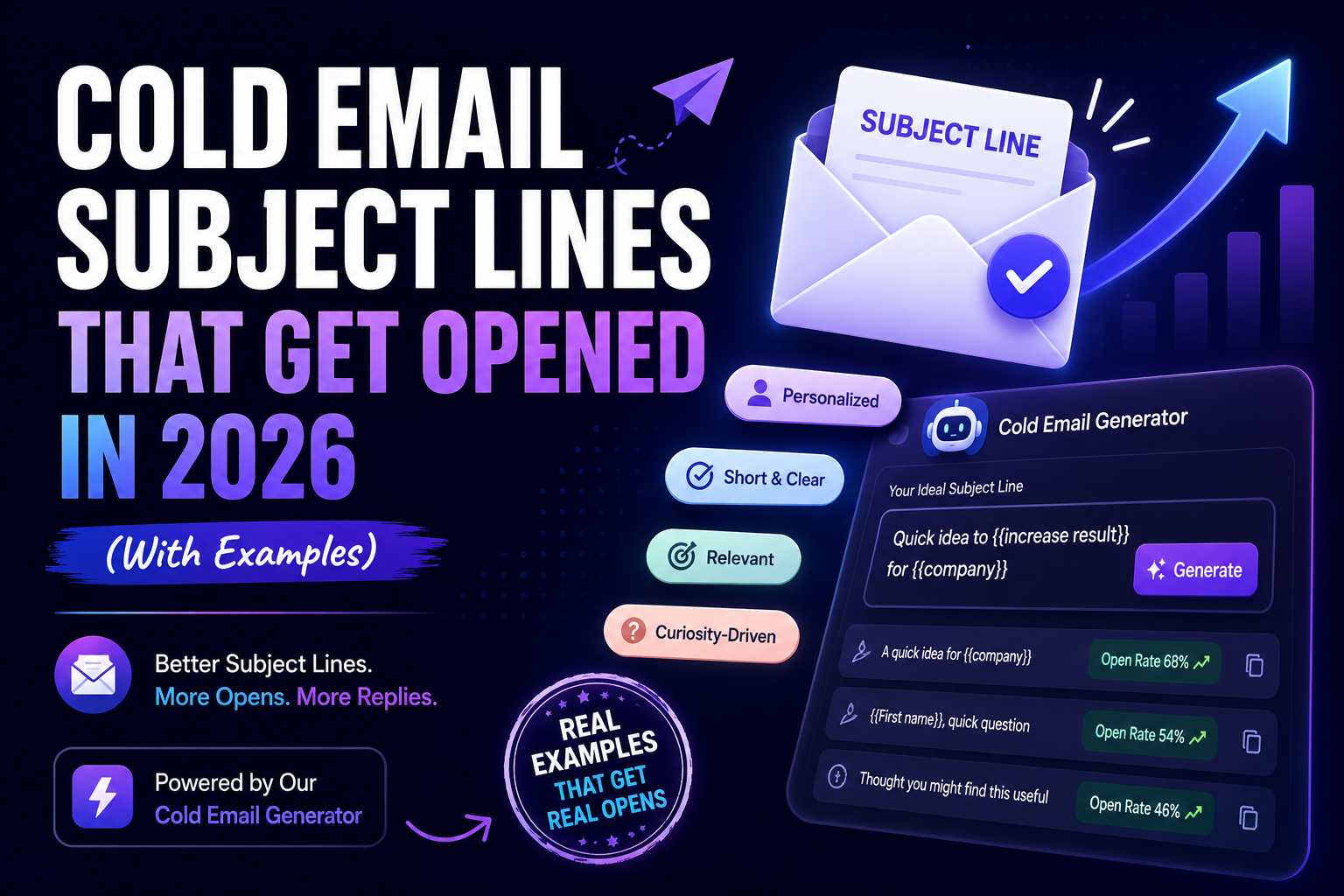
Want to put this into practice without starting from scratch? Our Cold Email Generator Tool lets you input your offer, audience, and tone — and builds out personalized subject lines and full email copy in under a minute.
Frequently Asked Questions
What's a good cold email open rate in 2026?
Anything above 30% is solid. Above 45% and your targeting and subject lines are genuinely dialed in. If you're consistently below 20%, the problem is usually either deliverability (check your domain health) or subject lines that are too generic for the list you're sending to.
How long should a cold email subject line be?
Short. Four to seven words is a good target. Under 50 characters ensures it shows fully on mobile, where more than half of emails are read. Every extra word costs you — cut ruthlessly.
Should I put the person's first name in the subject line?
Sometimes, but don't rely on it. First-name personalization is so common that it no longer signals genuine effort. More meaningful personalization — company name, a recent event, a shared connection — moves the needle more.
Do emojis work in cold email subject lines?
Depends on the audience. In B2C and creative industries, a well-placed emoji can increase open rates. In traditional enterprise B2B — finance, legal, healthcare — they tend to reduce credibility. When in doubt, leave them out.
Can I use AI to write cold email subject lines?
Yes, as a starting point. Generate options with AI, then edit them in your own voice. The ones that read as AI-generated — polished, generic, complete-sounding — usually underperform the ones that have a slightly rough, specific, human quality to them.
How often should I test new subject lines?
Rotate tests every two to three weeks. What resonates shifts over time, and subject lines that felt fresh in Q1 can feel tired by Q3. Build testing into your regular cadence rather than treating it as a one-time exercise.
More resources: Cold Email Body Copy That Converts · Follow-Up Email Templates That Don't Annoy People · Cold Email Deliverability Checklist for 2026