Key Insight: Google’s ranking systems don’t care who wrote the content—human or AI. They reward helpful, accurate, people-first content that demonstrates E-E-A-T (Experience, Expertise, Authoritativeness, Trustworthiness). The real question isn’t who wrote it, but how it was made and what it contains.
First, Let’s Clear Up What Google Actually Says
Google's official stance is that it doesn't care who wrote the content — human or AI. What it cares about is whether the content is helpful, accurate, and written for people rather than search engines. From their own documentation, Google's ranking systems reward "content that demonstrates expertise, experience, authoritativeness, and trustworthiness." That's the E-E-A-T framework, and it doesn't ask for a birth certificate. So technically, AI content can rank. Human content can rank. Garbage content from either source won't. The real conversation isn't about who wrote it. It's about what it contains and how it was made.
Where AI Content Tends to Fall Short
I'm not going to bash AI writing tools — they're genuinely useful. But there are real patterns worth being honest about:
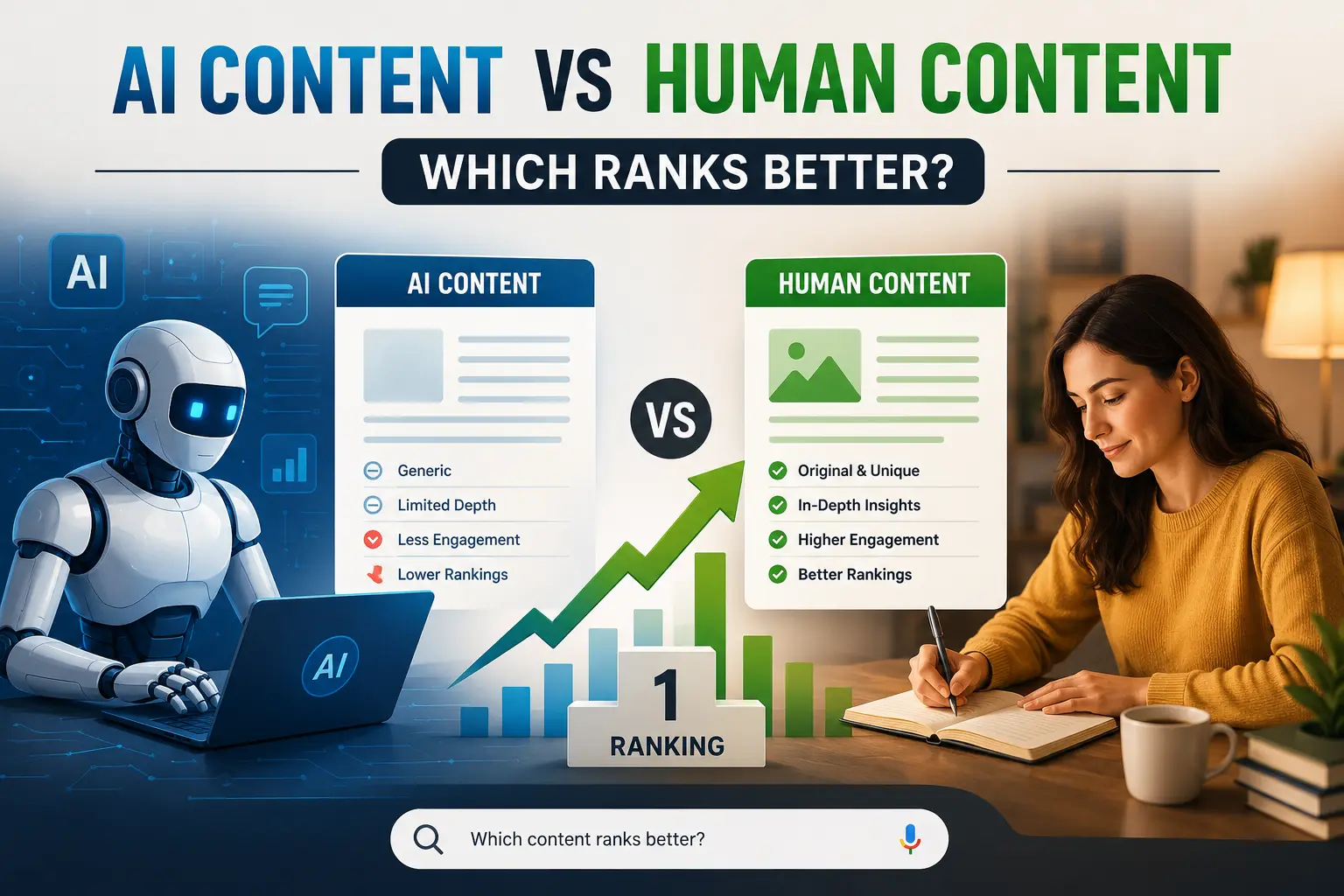
- Generic structure: Most AI content follows a predictable skeleton. Google has become remarkably good at identifying content that looks assembled from a template rather than written with a specific reader in mind.
- No real experience: AI hasn't used your product, visited the location, or made the mistake you're warning readers about. It cannot write from lived experience, and that gap shows.
- Thin on original insight: AI essentially remixes what already exists on the internet, rarely adding anything new — and Google increasingly rewards content that does.
- Outdated information: Most language models have a training cutoff. For recent changes, AI might confidently give you outdated information.
Where Human Content Has a Real Edge
Human writers who actually know their subject can do things AI genuinely cannot replicate — at least not yet. A writer with years of field experience naturally includes details that don't appear anywhere else online. They make connections, use specific real-world examples, and write with confidence that comes from deep knowledge rather than pattern-matching. Google's Helpful Content system was built specifically to surface this. Pages demonstrating first-hand experience consistently outperform assembled content. There's also the trust factor: a blog post from a real person with a real perspective tends to earn more backlinks, shares, and longer engagement — all signals that feed into rankings over time.
But Here’s What Most SEO Advice Gets Wrong
People treat this like a binary choice — either you use AI or you don't. The reality is far more nuanced. The content that consistently performs best right now is content that uses AI intelligently, combined with human expertise and editing.
AI + Human: The Winning Combination
Think of it this way. AI is excellent at structure, speed, and breadth. It can generate a solid draft in minutes. But what it produces still needs a human to add specificity, real examples, updated information, a genuine voice, and editorial judgment. When you use AI as a first draft and then genuinely improve it, you get content that's both efficient and substantive enough to compete.
What Google’s Algorithms Are Actually Measuring
Google's ranking systems don't scan a page and think "was this written by a human?" They measure signals that correlate with quality:
- Topical depth: Does the page cover the subject thoroughly, including aspects a knowledgeable person would include?
- User engagement: Do people stay on the page? High bounce rates and short dwell times will hurt rankings regardless of authorship.
- Backlink profile: High-quality sites link to credible, useful content. AI content at scale rarely earns natural backlinks.
- Freshness and accuracy: For changing topics, Google prioritizes recently updated, accurate content — an area where human oversight matters significantly.
Real Talk: What’s Actually Ranking Right Now
If you look at pages consistently sitting at the top of competitive SERPs in 2025 and 2026, a few patterns emerge:
- Long-form content with genuine depth outperforms thin articles regardless of production method.
- Pages with clear authorship — especially from people with demonstrable credentials — perform better in YMYL (Your Money, Your Life) categories.
- Content written for a specific audience, answering real questions in plain language, outperforms keyword-optimized fluff.
None of those are impossible for AI to produce — but they require thoughtful human direction to get right.
Pro Tip: If you're using AI to churn out hundreds of generic pages with no human refinement, hoping to rank through sheer volume — that strategy is increasingly ineffective. Google has been explicit about targeting exactly that kind of content.
The Bottom Line
If you're using AI as a productivity tool — to speed up research, structure your thinking, generate a first draft — and then adding genuine expertise, real examples, and human editing before you publish, there's no meaningful difference between that and traditional human writing from Google's perspective. The tool doesn't determine the quality. The process does. Good content ranks. Lazy content doesn't. That's really all Google is trying to say.
A Practical Takeaway
If you're managing a content strategy, here's a simple framework:
- Use AI to handle structure, research summaries, and first drafts.
- Then make sure a human who actually knows the topic adds specific experience, up-to-date details, a clear point of view, and editorial instinct to cut anything hollow.
| Approach | Likely Outcome |
|---|---|
| AI-only (no human editing) | Generic structure, outdated info, thin insights → struggles to rank |
| Human-only (no AI assistance) | High potential but slower, less scalable → can rank very well |
| AI + Human (intelligent combination) | Efficient, substantive, scalable → consistently best performance |
Tools like the GeoTools SEO Checker can help you audit what's already live and identify where your content is falling short on the signals that actually matter. Pair that with a thoughtful content process and you're in a much stronger position than relying on either AI or humans alone. The writers who are winning in search right now aren't choosing between AI and human content — they're using both intelligently.
GeoTools helps website owners with free AI-powered tools — including an SEO Checker, llms.txt Generator, FAQ Builder, and more. All free, no credit card required. Visit geotools.live to get started.