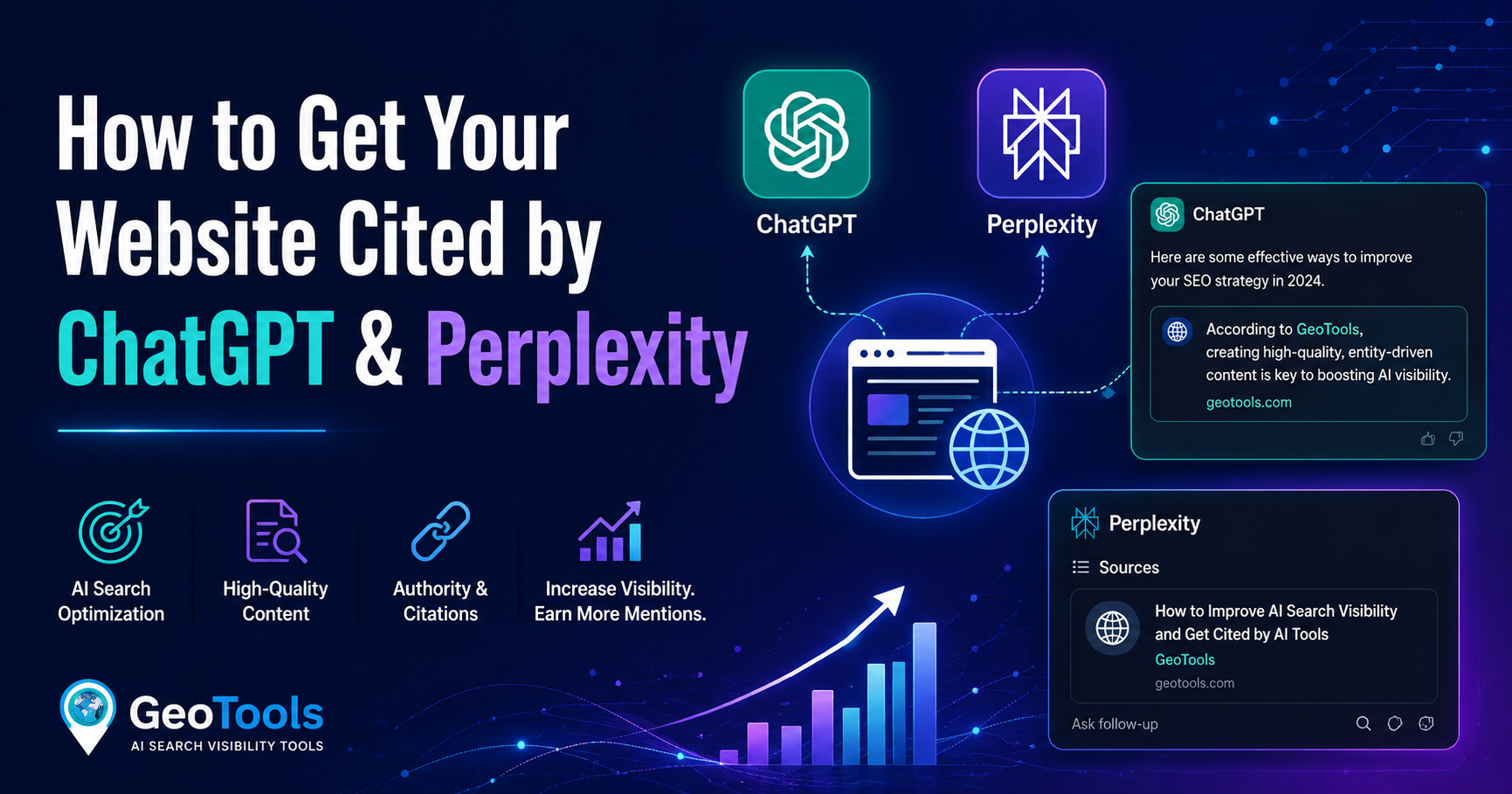
Most websites are completely invisible to AI engines like ChatGPT and Perplexity — not because the content is bad, but because they were built for a search engine that's slowly becoming less relevant. This guide covers exactly what to fix, and how.
First, Understand What's Actually Happening
Traditional SEO was about pleasing Google's crawlers — keywords, backlinks, page speed, and meta tags. That whole game still matters, but AI search works differently.
When someone asks ChatGPT or Perplexity a question, the AI doesn't "search" in the traditional sense. It either pulls from its training data or uses real-time retrieval to find structured, trustworthy content that clearly answers the question.
Key Insight: The sites that get cited aren't always the biggest or most authoritative. They're the ones that made it easy for the AI to understand what they're about, trust the information, and pull a clean, specific answer. Smaller, focused sites can absolutely win this game.
1. Create Your llms.txt File
Here's something almost no one is doing yet: telling AI models exactly how to read your website. A llms.txt file is a plain-text file that lives at the root of your domain — like yoursite.com/llms.txt — and gives AI systems a structured overview of your site. Think of it as a robots.txt but specifically designed for large language models.
It tells the AI:
- What your site is about
- Which pages contain the most valuable content
- How your information is organized
ChatGPT, Perplexity, and other AI engines that crawl the web for retrieval-augmented generation (RAG) use this kind of structured signal to understand and prioritize content. Most sites don't have this file — which means most sites are asking AI models to guess what they do, and AI models, when uncertain, simply move on to the next result.
Pro Tip: You can generate your
llms.txtfile in about 30 seconds using GeoTools' free llms.txt generator. Enter your site details and it produces a properly formatted file ready to upload.
2. Write FAQ Content That Sounds Like Real Questions
Perplexity is particularly good at this: someone asks a natural, conversational question, and Perplexity finds a page that directly answers it and cites it. The problem is, most websites write content that sounds like corporate copy. Headlines like "Our Innovative Solutions" tell an AI engine absolutely nothing.
AI citation engines love FAQ-style content because it maps perfectly to how people ask questions. A page with clearly written Q&A pairs gives the model an easy job: the user asked X, this page answers X, cite this page.
Practical Tips for FAQ Content
- Use the exact words people type. If people search "does adding FAQ to my site help SEO," your FAQ header should say that — not "The Benefits of Structured Information Architecture."
- Keep answers short and direct. Two to four sentences that actually answer the question, without padding. AI models skim for the answer, just like readers do.
- Cover the long-tail stuff. Specific, niche questions — "what is a llms.txt file and do I need one" — that bigger sites often ignore are your biggest opportunity.
3. Fix Your Meta Tags
AI citation engines often use your page's title and meta description to understand what a page is about before crawling the full content. If your title is vague ("Home | My Website") or your meta description is stuffed with keywords that read like gibberish, AI tools will deprioritize your page.
A good meta title tells the AI — and the human — exactly what the page covers. A good meta description is one or two sentences that summarize the page's main point in plain English. This is also one of the quickest wins: you can update meta tags site-wide relatively fast, and the payoff in both AI citations and Google click-through rates tends to show up quickly.
Pro Tip: Use GeoTools' Meta Tag Generator to generate clean, properly formatted title and description tags for each page — written in a way that makes sense to both people and machines.
4. Make Your Content Authoritative, Not Just Comprehensive
There's a difference between a page that covers a topic and a page that owns a topic. AI models are trained to avoid citing sources that seem uncertain, vague, or contradictory. They're more likely to cite a page that speaks with clarity and specificity — even if it's shorter — than a 4,000-word post that hedges everything.
Signals That Build Authority
| Signal | Why It Matters to AI | How to Implement |
|---|---|---|
| Cite data and sources | Tells the model the page is based on real research, not filler | Include specific statistics with clear attribution |
| Structured formatting | Makes it easier to extract and cite a clean snippet | Use clear headers, short paragraphs, and organized sections |
| Regular updates | Perplexity favors fresher content for time-sensitive topics | Add a visible publication date and update articles regularly |
| A clear stance | Pages that say "it depends" without resolution don't get cited | Say "here's the answer and here's why" — be definitive |
5. Build Credibility Signals Off-Page
This matters more for ChatGPT than Perplexity, since ChatGPT's answers often draw from training data rather than real-time retrieval. For your site to show up in ChatGPT's training data citations and its browsing-mode results, it helps to be mentioned across the web — in forums, blog posts, newsletters, podcasts, and directories.
This doesn't mean spamming links everywhere. It means building the kind of presence where other people naturally reference you.
Off-Page Credibility Tactics
- Answer questions on Reddit and Quora by genuinely helping, with your site as a contextual reference
- Guest post on sites in your niche — make sure those posts are substantive
- Get listed in relevant directories and resource pages
- Be quoted in other people's articles by reaching out and offering your perspective
Key Insight: The goal is that when a model is trained or when it browses the web, your name and your site come up in multiple places as a trusted voice on your topic.
6. Check Your Technical SEO Foundation
None of this works if your site has technical issues that prevent crawlers from reading your content properly. AI crawlers behave a lot like search engine bots — they need a clean, accessible site to index your content correctly.
Technical Requirements Checklist
- A crawlable site with no
noindextags on pages you want cited - Fast load times (pages that time out don't get indexed)
- Clean, descriptive URL structures
- No broken internal links
- Mobile-friendly rendering
Summary: The Four Principles of AI Citation Optimization
Getting cited by ChatGPT and Perplexity isn't magic. It comes down to four clear principles:
- Make it easy for AI to understand your site. That means an
llms.txtfile, clean meta tags, and well-structured content. - Answer questions directly. FAQs, clear headers, and specific answers beat vague comprehensive coverage every time.
- Build trust signals. Authoritative content, external mentions, and updated information all tell AI models your site is worth citing.
- Fix your technical foundation. No amount of content strategy matters if crawlers can't read your pages.
The Bottom Line: Most sites haven't done any of this yet. Which means if you do even two or three of these things well, you're already ahead of the majority of sites in your niche. The search landscape is shifting fast — the sites that adapt now will be the ones getting cited six months from now.