There's a question I keep hearing from site owners who are stuck: "I'm publishing content consistently, getting some backlinks, doing everything right — so why isn't Google ranking me?"
Nine times out of ten, the answer isn't a technical issue. It's not a slow page speed or a missing alt tag. It's something more fundamental.
They haven't convinced Google that they own a topic.
That's what topical authority is really about. Not tricks. Not hacks. Just becoming the site Google trusts enough to send people to when they have a serious question in your niche.
In 2026, this matters more than ever. Google's gotten remarkably good at recognizing surface-level content farms from sites that genuinely know what they're talking about. If you want to compete — especially in a space like geospatial tools, mapping, or location tech — you need to think like a subject matter expert, not a content scheduler.
What Is Topical Authority (Really)?
You've probably heard it defined as "covering a topic comprehensively." That's true, but it's a bit like saying swimming is "moving through water." Technically accurate, misses the point.
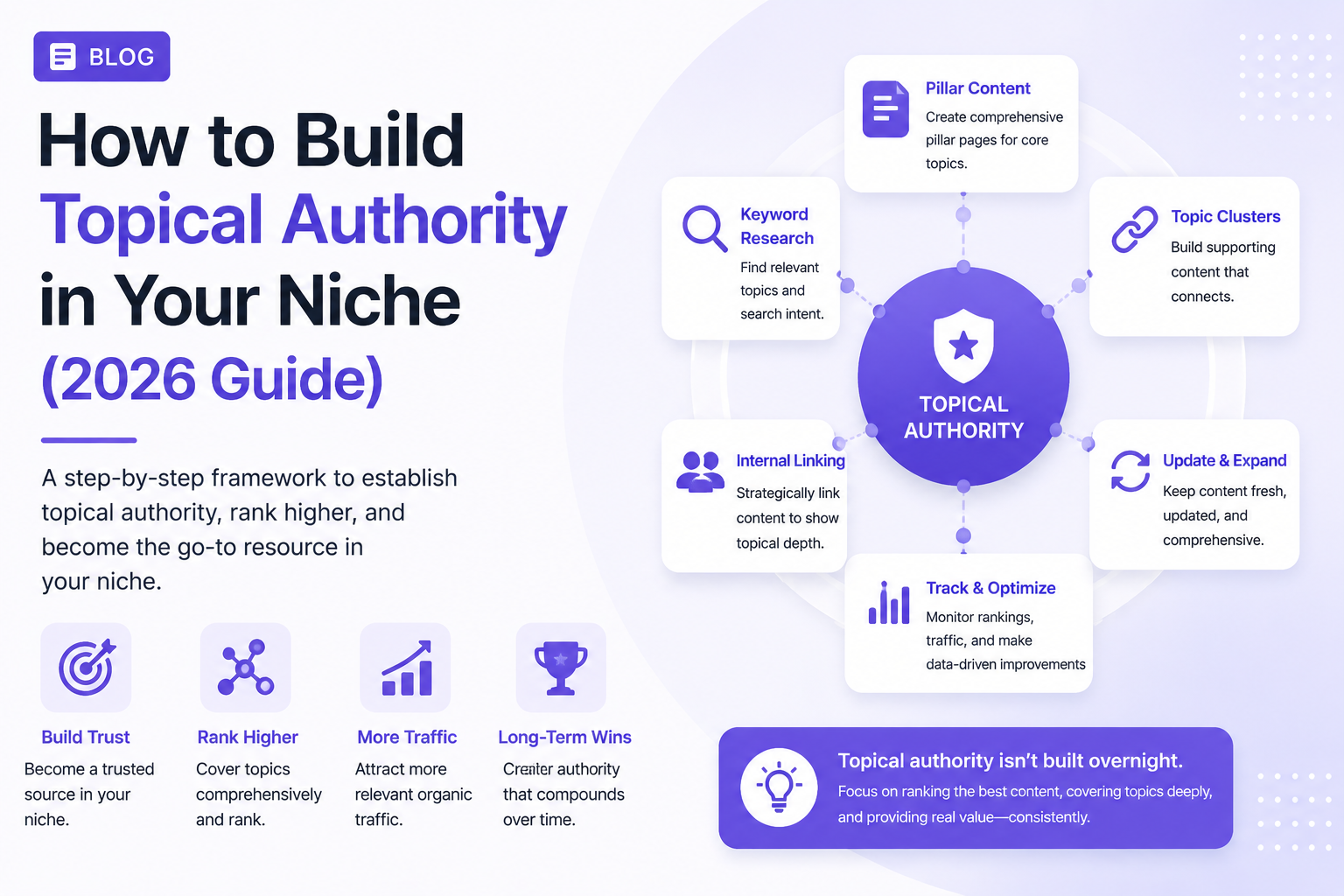
Topical authority is the degree to which a search engine trusts your site to give accurate, complete, and useful answers about a specific subject. It's built over time through a combination of content depth, internal linking, entity relationships, and what users actually do when they land on your pages.
Key Insight: Google is trying to figure out which sites are the "doctor friend" in every niche — the one whose answer you trust over a generic search result. Your job is to become that for your audience.
The shift that's happened over the last two years is that keyword-by-keyword ranking has become less predictable. Sites that rank for one keyword in a cluster often end up ranking for dozens of related ones they never explicitly targeted. That's topical authority doing its work quietly in the background.
Why This Matters Even More in Specialized Niches
Here's something the generic SEO guides won't tell you: topical authority is actually easier to build in a specialized niche than in a broad one.
If your site is about geospatial tools — things like coordinate converters, distance calculators, map projections, GIS workflows — you're not competing with Wikipedia or massive media companies. You're in a space where genuinely deep, accurate, practitioner-level content is rare. Most people writing about these topics are either too academic or too shallow.
Pro Tip: A civil engineer who needs to convert between coordinate systems doesn't want a blog post that explains what GPS is. They want to know the difference between WGS84 and NAD83, when it matters, and how to handle the conversion without screwing up a survey. That precision gap is your opportunity.
Step 1: Define Your Topical Universe Before You Write a Word
The biggest mistake I see people make is jumping straight to a keyword list. Keywords come later. First, you need to map your universe.
Sit down and ask yourself: what is every single thing someone in my niche might need to know, do, or figure out? Don't filter yet. Just list.
For a site focused on geo tools, that universe might include:
- How coordinate systems work (WGS84, UTM, local datums)
- The difference between geolocation and geocoding
- How to measure distance on a sphere vs. a flat plane
- What projection to use for different map types
- How GIS tools like QGIS or ArcGIS handle spatial data
- Practical use cases: surveying, real estate, logistics, urban planning
- Common errors when working with lat/long data
- How APIs like Google Maps or Mapbox handle coordinates behind the scenes
Key Insight: That's not a keyword list — that's a content ecosystem. The keywords emerge from it naturally. The goal is to see the full landscape before you start building, so there are no obvious gaps when someone looks at your site.
Step 2: Build Content Clusters, Not Pages
Old-school SEO thought in terms of individual pages. Topical authority thinks in terms of clusters.
The Three Parts of a Content Cluster
- The Pillar Page: A comprehensive piece covering the broad topic at a high level. It touches on every major sub-topic but doesn't go deep on any of them. Its job is to orient the reader and link out to detailed pieces.
- Cluster Content: Deep-dive pieces on each specific sub-topic. Each one fully answers a narrow question and links back to the pillar.
- Supporting Content: Glossaries, comparisons, case studies, tool guides — pieces that add context and reinforce authority around the edges.
Real-World Cluster Example for a Geo Tools Site
| Content Type | Title / Topic |
|---|---|
| Pillar Page | The Complete Guide to Map Projections |
| Cluster Article | Mercator vs. Robinson: When to Use Each |
| Cluster Article | How to Choose the Right Projection for Your Data |
| Cluster Article | The Math Behind UTM Zones (Explained Without Formulas) |
| Cluster Article | Common Projection Errors and How to Fix Them |
| Cluster Article | How QGIS Handles Coordinate Reference Systems |
| Supporting Content | Glossary of Map Projection Terms |
| Supporting Content | Case Study: Choosing the Right Projection for Urban Planning |
Every piece links to the pillar. The pillar links to every piece. Google crawls that web of internal links and starts to understand: this site really knows map projections. Do this for five or six core topics, and you've built something that's very hard for a thin competitor to replicate quickly.
Step 3: Entities Matter as Much as Keywords
This is where 2026 SEO diverges from what worked in 2019. Google doesn't just read words anymore. It recognizes entities — real-world concepts, places, organizations, people — and understands how they relate to each other.
For geo tools, your content should naturally mention and correctly use terms like:
- Specific coordinate systems (EPSG:4326, EPSG:3857)
- Named algorithms (Haversine formula, Vincenty's formula)
- Real software and APIs (QGIS, PostGIS, Mapbox, OpenStreetMap)
- Real use-case domains (cadastral mapping, remote sensing, photogrammetry)
Pro Tip: After you publish a piece, read it aloud. Does it sound like something a knowledgeable practitioner would actually say? Or does it sound like it was assembled from search results? The difference is obvious to your ear — and increasingly obvious to Google too.
Step 4: Don't Neglect the Content You Already Have
Before you write fifty new articles, look at what you already have. Most sites carry a graveyard of thin, outdated, or unfocused content that's quietly dragging down their overall authority. An internal audit is unglamorous work, but it pays off.
The Four-Bucket Content Audit System
| Bucket | Action | When to Use It |
|---|---|---|
| Keep & Improve | Update and expand | Good topic, good intent, just needs freshening up |
| Consolidate | Merge into one piece | Two or three thin posts covering the same topic |
| Redirect or Delete | Remove from index | Off-topic or low-quality with no salvageable value |
| Repurpose | Change format | Content that works better as a table, video, or pillar section |
This cleanup signals to Google that your site takes quality seriously. It concentrates your authority rather than spreading it thin.
Step 5: Internal Linking Is the Architecture of Authority
A lot of people treat internal linking like an afterthought. But done intentionally, internal linking is how you tell Google which pages matter and how topics relate to each other.
- Every cluster page should link to its pillar
- Every pillar should link to all its cluster pages
- Supporting content should link to both
- When you publish something new, add links to it from two or three older, already-ranking pages
Pro Tip: Keep a simple spreadsheet of your most important pages and track how many internal links point to each. Your pillar pages should have the most. If a critical page has only one or two internal links, that's a gap worth fixing immediately.
Step 6: Think About Who's Citing You
Backlinks still matter in 2026. But the type of backlinks matters more than ever. For topical authority, the most valuable links come from:
- Other sites in your niche or adjacent niches
- Educational or institutional sites referencing your tools or content
- Practitioner communities: Reddit, GIS-specific forums, Stack Exchange, Discord servers
- Resource pages that curate useful tools in your space
The way to earn them isn't to run cold outreach campaigns. It's to publish things people in your niche actually want to share — genuinely useful tools, honest comparisons, reference content that doesn't exist elsewhere in a usable form.
Key Insight: For GeoTools, that might mean a coordinate converter that handles edge cases correctly, a visual explanation of Mercator distortion, or a clear breakdown of Haversine vs. Vincenty. Make the thing. Share it where your audience lives. Let the links follow from genuine usefulness.
Step 7: Earn Trust Through Consistency and Transparency
This is the part most SEO guides skip because it's hard to measure: trust signals that come from being a real, transparent site.
In 2026, Google is paying attention to:
- Whether your content is dated and regularly updated
- Whether your authors have real expertise (bios, bylines, credentials)
- Whether you link out to authoritative external sources when appropriate
- Whether your site has core E-E-A-T signals: company info, contact details, transparent ownership
E-E-A-T Checklist for GeoTools
| Signal | Implementation |
|---|---|
| Experience | Author bios explaining practitioner background |
| Expertise | Correct use of technical entities (EPSG codes, named algorithms) |
| Authoritativeness | Links from GIS communities, academic, and institutional sources |
| Trustworthiness | Honest comparisons, documented review dates, links to official docs (e.g., EPSG.io) |
Users and search engines alike reward intellectual honesty. A post that says "Tool A is better for X, but Tool B handles Y better" is more trustworthy than one that declares a clear winner with no nuance.
How Long Does This Actually Take?
Building genuine topical authority in a competitive niche takes time. If you're starting from scratch, you're probably looking at six months before meaningful movement, and twelve to eighteen months before the compounding effects really kick in.
Key Insight: That's not a bug in the strategy — it's a feature. The difficulty of doing this is exactly what makes it defensible once you've done it. A competitor can't buy topical authority. They have to earn it the same slow way you did.
The sites that struggle are the ones that start strong and then slow down — publish twelve cluster articles, see no immediate rankings, and pivot to the next tactic. The sites that win keep going: plugging gaps, updating old content, building the cluster until there's genuinely nowhere else to go in the niche.
How to Track Topical Authority Progress
You don't need sophisticated tools to know if topical authority is building. Watch for these signals in Google Search Console:
- Branded search volume increasing: People searching for your site by name means community awareness is growing.
- Pages you didn't optimize starting to rank: Showing up for untargeted queries means your topical signals are working.
- Average position improving across a cluster: Slow, steady improvement in average position signals building authority.
- Organic click-through rate going up: As your brand becomes recognized in SERPs, users are more likely to choose your result.
Pro Tip: Track these metrics monthly in Google Search Console. The trends matter far more than any single data point.
The Bottom Line
Topical authority isn't a shortcut. It's the opposite of a shortcut — it's the long road that most people aren't willing to take, which is precisely why it works so well for the ones who do.
For a site like GeoTools, the opportunity is real and relatively accessible. The geospatial space has plenty of tools but not many sites that actually educate practitioners at depth. Building that educational layer — covering the concepts, the edge cases, the workflows, the comparisons — is how you stop being just another tool site and start being the resource people in the space actually trust.
Pick one cluster. Build it out completely. Then do the next one.
That's the whole strategy. It's not glamorous. But twelve months from now, you'll be glad you started today instead of waiting for a better shortcut that isn't coming.