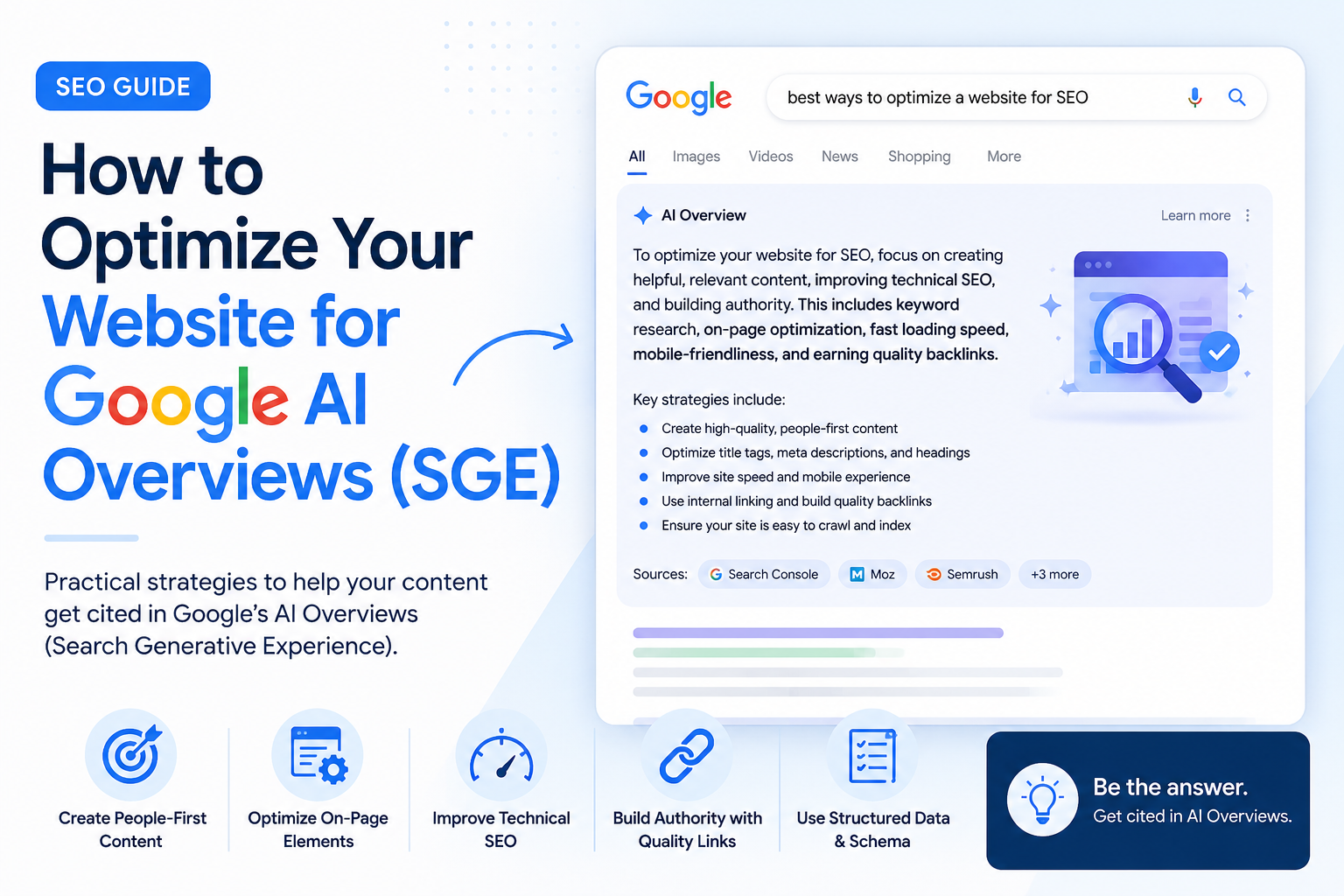
How to Optimize Your Website for Google AI Overviews (SGE)
The core challenge
SGE and AI Overviews demand a new balance: content specific enough to be cited as authoritative, yet broad enough to attract meaningful search traffic. Generic SEO tactics won't get you featured — but overly niche content won't bring visitors either.
Google's AI Overviews (previously called Search Generative Experience, or SGE) have fundamentally changed what it means to appear at the top of a search results page. Instead of a blue link, users now see an AI-generated paragraph — sourced from multiple websites — sitting above everything else. If your site gets cited, you earn prime visibility. If it doesn't, you may find your traffic quietly eroding even when you rank highly in traditional results.
This guide breaks down exactly how AI Overviews work, what separates them from general AI SEO, and the specific, field-tested strategies that get websites included in these AI-generated snapshots.
What Are Google AI Overviews?
Google AI Overviews are AI-generated summaries that appear at the very top of the search results page for eligible queries. Launched broadly in 2024 and refined throughout 2025, they synthesize information from multiple web sources into a single, conversational answer. Each overview links out to the pages it cited, giving those sources a highlighted placement that often outperforms even the first organic result.
Originally named the Search Generative Experience (SGE) during Google's testing phase, the feature is now simply called AI Overviews in most markets. It appears for a wide range of queries — how-to questions, product comparisons, complex factual lookups, and nuanced "what should I do" searches — but not for all queries. Straightforward navigational searches ("YouTube") and highly sensitive topics (medical diagnoses, legal advice) often trigger different treatments.
"Being cited in an AI Overview is not the same as ranking #1. It is closer to being quoted by a journalist — authority, clarity, and trust are the price of entry."
SGE Optimization vs. General AI SEO
A growing category of SEO advice lumps "AI search" into one bucket. That conflates two very different problems. General AI SEO often refers to optimizing for AI-powered tools like Perplexity, ChatGPT's web mode, or Bing Copilot. Google AI Overviews are a distinct surface with their own selection logic.
| Dimension | General AI SEO | Google AI Overviews (SGE) |
|---|---|---|
| Primary goal | Get cited across AI assistants broadly | Appear in Google's SERP-embedded AI snapshot |
| Query types | Conversational, open-ended | Informational, comparative, procedural |
| Key signal | Brand mentions and backlink authority | Structured, specific answers with clear sourcing |
| Traffic impact | Broad referral from AI tools | Click-through from Google's citation links |
| Schema priority | Organization, Product, Review | FAQ, HowTo, Article, Speakable |
| Content length | Comprehensive (depth wins) | Concise, scannable, with a direct answer above the fold |
The core tension in AI Overviews optimization is the specificity-traffic tradeoff. A page that answers "What is the ideal soil pH for growing blueberries in a raised bed in a humid climate?" is extremely specific — exactly the kind of precise, citable answer Google's AI pulls from. But that query has low search volume. A page targeting "best gardening tips" is broad enough for traffic but too vague to earn a citation. The sweet spot is a cluster of mid-specificity, question-based queries where your page is the clearest, most authoritative answer available.
How Google Selects Sources for AI Overviews
Google has not published a complete technical specification for its AI Overviews sourcing algorithm, but patterns observed across thousands of queries — and guidance from Google's own search documentation — point to several strong signals.
E-E-A-T Quality
Experience, Expertise, Authoritativeness, and Trustworthiness. Pages written by credible authors on topics within their demonstrated domain consistently earn more AI citations.
Direct Answer Presence
Pages that contain a clear, self-contained answer to the query — typically in the first 100–150 words — are disproportionately cited. The AI needs extractable content.
Structured Data
Schema markup (especially FAQ, HowTo, and Article schema) gives Google machine-readable signals about the nature, structure, and intent of the content.
Traditional Ranking Strength
Pages that already appear in the top 10 organic results for a query are far more likely to be cited. AI Overviews source from content Google already trusts.
Content Freshness
For evolving topics — software, regulations, statistics — recently updated content is strongly preferred. Timestamp your updates and review content regularly.
Source Diversity
Google tends to pull from multiple domains. A source that covers a niche comprehensively — rather than a bit of everything — is more likely to be the authoritative pick for that niche.
Core Optimization Strategies
1. Build an Answer-First Content Architecture
The single most impactful structural change you can make is placing a direct, concise answer immediately after the H1 or introductory paragraph. This "answer block" should be 2–4 sentences that fully resolve the user's query — without requiring them to scroll. Think of it as the content Google's AI will excerpt. Everything else on the page — the depth, the examples, the nuance — supports and expands that central answer.
Pro tip: Use a visually distinct block (a border-left, a light background, or a bold lead sentence) to signal to both readers and crawlers where your direct answer lives. This mirrors the structure Google's systems are optimized to detect.
2. Target Conversational, Question-Based Queries
AI Overviews appear most frequently on queries phrased as questions or that imply a question (even when typed as fragments). Use keyword research tools to identify your topic's "People Also Ask" universe, then build dedicated sections — or entire pages — around each question. Tools like Google Search Console, Semrush's Question keyword filter, and AlsoAsked are valuable here.
The ideal query format for AI Overview targeting tends to follow one of these patterns: "How do I [task] when [condition]?", "What is the difference between [X] and [Y]?", "Why does [phenomenon] happen?", or "What is the best [thing] for [specific use case]?"
3. Strengthen Your E-E-A-T Signals
Every page that earns an AI Overview citation has one thing in common: Google trusts the source. Building that trust is a long game, but the levers are well-understood. Add a detailed author bio with credentials and relevant experience. Link to primary sources (studies, official documentation, government data). Keep a consistent publication history on your core topic cluster. Get quoted or linked by recognized publications in your field.
4. Use Semantic Content Clusters, Not Isolated Pages
A single optimized page is unlikely to earn AI Overview citations consistently. What works is a topic cluster: a central pillar page supported by a network of related subtopic pages, all interlinked. This cluster model tells Google that your site owns a topic comprehensively, not just tangentially. Pages within a strong cluster benefit from the topical authority of their neighbors.
Schema Markup That Helps AI Overviews
Structured data doesn't guarantee an AI Overview citation, but it dramatically improves Google's ability to parse and classify your content. The following schema types have the strongest correlation with AI Overview sourcing.
-
FAQPage Schema
Mark up every question-and-answer section of your content with FAQPage schema. This directly communicates to Google's systems that your page contains discrete, extractable answers — the raw material for AI Overviews.
-
HowTo Schema
For any process or tutorial content, HowTo schema labels each step individually. Google can then surface individual steps in overviews for "how to" queries, with your domain cited as the source.
-
Article / BlogPosting Schema
Always include Article schema with accurate
datePublishedanddateModifiedproperties. Freshness signals matter significantly for AI Overviews on fast-moving topics. -
Speakable Schema
Originally designed for voice search, Speakable schema marks specific passages as ideal for audio playback — but it also signals to Google's AI which sections of your content are designed to be read aloud or quoted verbatim. High-signal for AI Overviews.
-
BreadcrumbList Schema
Breadcrumb schema reinforces your site's topical hierarchy and helps Google understand where a page sits within your site structure — supporting the topical authority signals that underpin AI Overview selection.
Here is a minimal FAQPage schema example for a blog post section:
{
  "@context": "https://schema.org",
  "@type": "FAQPage",
  "mainEntity": [
    {
      "@type": "Question",
      "name": "How do I appear in Google AI Overviews?",
      "acceptedAnswer": {
        "@type": "Answer",
        "text": "Optimize for direct, structured answers,
                 use FAQ and HowTo schema, build topical
                 authority through content clusters, and
                 ensure your page already ranks in the
                 top 10 for the target query."
      }
    }
  ]
}
Content Structure Checklist
Before publishing or updating any page you want considered for AI Overviews, run through this structural checklist:
| Element | Requirement | Why It Matters |
|---|---|---|
| Direct answer block | Within first 150 words | Extractable answer for the AI snapshot |
| H1 tag | Contains the primary question or keyword | Signals the page's primary topic to Google |
| H2/H3 headings | Phrased as questions or clear topic labels | Creates citable, segmented content blocks |
| Author bio | Named author with credentials and links | E-E-A-T trust signal |
| Last updated date | Visible and accurate | Freshness signal for competitive topics |
| Internal links | 3–5 links to related topic cluster pages | Reinforces topical authority |
| External citations | Primary sources (studies, official docs) | Adds credibility; signals expert-level research |
| FAQ section | At least 3 Q&A pairs, schema-marked | Directly feeds AI Overview extraction |
| Page load speed | Core Web Vitals in green | Technical prerequisite for Google trust |
| Mobile rendering | Fully responsive, no content clipping | Mobile-first indexing affects all rankings |
What to Avoid
Some common SEO practices actively hurt your chances of being cited in AI Overviews. Being aware of these pitfalls is as important as implementing the positive strategies above.
Avoid burying your answer. Long introductions that restate the question, delay the answer with filler phrases ("In this comprehensive guide, we will explore…"), or bury the key information below multiple sections are a liability. The AI needs to extract your answer cleanly — if it can't find it quickly, it won't cite you.
Avoid over-optimization for traditional featured snippets. The tactics that worked for featured snippets (very short, highly formatted answer boxes) don't map cleanly to AI Overviews. AI Overviews often pull more nuanced, paragraph-length responses that demonstrate genuine understanding, not just keyword matching.
Avoid thin content clusters. A site with one excellent page surrounded by low-quality filler content sends mixed authority signals. Every page in your cluster should be substantive enough to stand alone.
Avoid ignoring multi-modal content. AI Overviews increasingly incorporate images, video thumbnails, and data visualizations in their outputs. Pages with well-labeled images (alt text, descriptive filenames), embedded video, and original data are better positioned as Google expands the visual scope of AI Overviews.
Measuring Your SGE Visibility
Tracking AI Overview performance is still an evolving discipline — Google Search Console does not yet provide a dedicated AI Overviews filter. However, several approaches give useful signal.
Use Google Search Console's Search Results report filtered to queries where you appear in positions 1–5. Cross-reference these with manual SERP checks (use incognito mode to avoid personalization) to see which queries trigger AI Overviews. Track your click-through rate on high-impression queries over time — a CTR drop on a query where you still rank highly is a potential signal that an AI Overview has absorbed the click intent above you.
Third-party tools including Semrush, Ahrefs, and BrightEdge have introduced AI Overview tracking features throughout 2025, giving you dashboards showing which of your tracked keywords now trigger AI Overviews and whether your domain is cited in them.
Quick win: Set up a weekly Search Console export filtered to queries with >500 impressions and <3% CTR. These are your priority candidates for AI Overview investigation — high visibility but low clicks often means an AI Overview is answering the question before users click through.
Frequently Asked Questions
What is Google AI Overviews (SGE)?
Google AI Overviews (formerly Search Generative Experience or SGE) are AI-generated summaries that appear at the top of Google search results for eligible queries. They pull from multiple trusted web sources to produce a synthesized answer, with citation links to the pages they referenced.
How do I get my website featured in Google AI Overviews?
Focus on publishing structured, authoritative content that answers specific questions directly. Use FAQ and HowTo schema markup, build topical authority through content clusters, establish strong E-E-A-T signals with credentialed authors and primary source citations, and ensure your pages already rank in the top 10 organic results for your target queries.
Is SGE optimization different from traditional SEO?
Yes, significantly. Traditional SEO prioritizes ranking for broad, high-volume keywords through backlink authority and keyword density. SGE optimization requires content that is specific enough to be citable by an AI system, structured for extraction, and authoritative enough for Google to trust as a sourced reference — all while maintaining enough search volume to drive meaningful traffic.
Does ranking on page one guarantee an AI Overview citation?
No. Ranking in the top 10 is a strong prerequisite, but it does not guarantee citation. The AI selects sources based on the quality, structure, and extractability of the specific content on the page — not just the overall authority of the domain.
How often do AI Overviews appear in search results?
As of mid-2025, AI Overviews appear for an estimated 15–30% of all Google searches, with the highest frequency on informational, how-to, and comparison queries. The rate varies significantly by industry and query type, and Google continues to adjust the rollout.
Ready to Rank in AI Overviews?
Get our free SGE content audit checklist — 47 actionable items to benchmark your pages against Google's AI sourcing signals.
Download Free Checklist →